Question
What does Matrixyl do for skin?
Quick Answer
Matrixyl is a cosmetic signaling peptide — specifically Palmitoyl Pentapeptide-4, also called Pal-KTTKS — used in leave-on serums and creams positioned for the appearance of fine lines and wrinkles. In peer-reviewed cosmetic-peptide reviews, it is described as a "messenger" molecule that cues dermal fibroblasts toward producing extracellular-matrix proteins such as collagen, with appearance-level changes typically reported over study windows of roughly 8 to 12 weeks. The cosmetic-appearance evidence base is real but modest, and most published studies are small, short, and often manufacturer-funded. Matrixyl is not a neuromodulator, not a prescription anti-aging therapy, and not interchangeable with the differently-named Matrixyl 3000 or Matrixyl Synthe-6 compositions.
What Matrixyl actually is
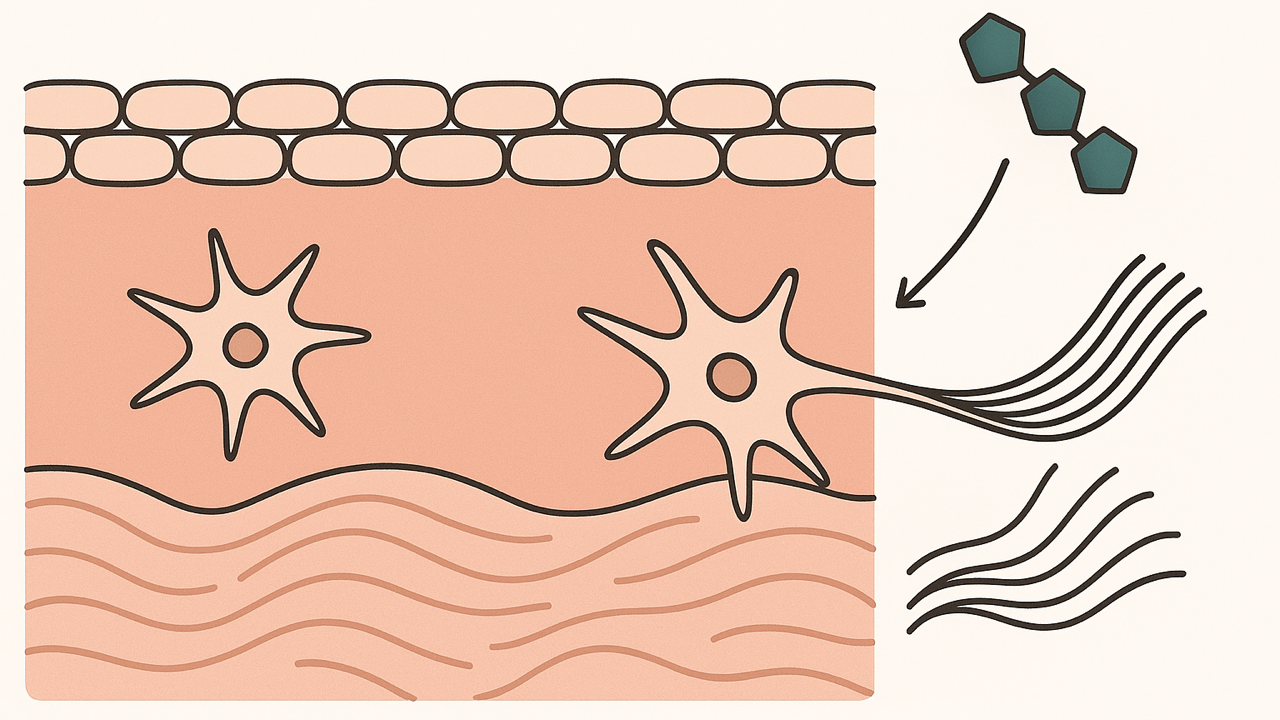
Matrixyl is the trade name commonly used by formulators for Palmitoyl Pentapeptide-4, a five-amino-acid signaling peptide attached to a palmitic-acid (fatty) tail. The peptide sequence itself is derived from a fragment of type I procollagen, and the abbreviation Pal-KTTKS — palmitoyl plus the amino-acid letters of the pentapeptide — is how it is most commonly written in scientific literature. The fatty tail is added to help the peptide pass through the lipid-rich outer layer of skin in a leave-on cosmetic.
It is important to distinguish Matrixyl from its sister compositions: Matrixyl 3000 (a blend of Palmitoyl Tripeptide-1 and Palmitoyl Tetrapeptide-7) and Matrixyl Synthe-6 (Palmitoyl Tripeptide-38). These are different molecules with different chemistry and different studies behind them. A claim about "Matrixyl" in marketing copy may not refer to the same molecule from one product to another, and the cosmetic-appearance evidence base does not transfer automatically across the three.
How it is described in cosmetic-appearance literature
Modern cosmetic-peptide reviews — including the widely cited Schagen 2017 overview, the Fields signaling-peptide review, and the Lupo & Cole cosmeceutical-peptide review — group Matrixyl with signaling (matrikine) peptides. These reviews describe such peptides as cueing dermal fibroblasts toward producing extracellular-matrix proteins such as collagen I and III, fibronectin, and glycosaminoglycans. The original mechanism description is most often traced back to Katayama and colleagues, who reported that a pentapeptide derived from type I procollagen could promote extracellular-matrix production in cultured fibroblast models.
In topical cosmetic studies on humans, the appearance-level outputs typically reported include the look of finer lines, smoother surface texture, and modest improvements in self-rated firmness. Reported study windows are typically around 8 to 12 weeks, which is the range consumers should also expect before judging a leave-on cosmetic peptide.
Does it really work?
The honest answer is: modestly, and gradually, with limits worth naming.
The cosmetic-appearance evidence base for Matrixyl-style pentapeptides is real. Peer-reviewed reviews and original studies have associated these peptides with improvements in the look of fine lines and skin texture in human cosmetic studies. At the same time, the same reviews consistently flag three limits: study sizes are usually small, study durations are usually short, and a meaningful share of the work is manufacturer-funded. Many studies measure biomarker outputs (changes in protein production in cultured cells or biopsy samples) rather than visible-appearance endpoints rated by trained graders.
In practice, the cosmetic-appearance reviews position peptides as one supporting element of a layered routine, not a single dominant active. Daily sun protection remains the most consistent lever for the long-term look of skin. Matrixyl in a leave-on serum is positioned as a gradual contributor on top of that base.
What it is not
Matrixyl is not a neuromodulator. It does not relax facial muscles in the way that injectable neuromodulators do, and "topical Botox"-style framing is not an accurate description of the cosmetic-peptide category. Matrixyl is not a prescription anti-aging therapy and is not in the retinoid family. It is also not interchangeable with related-named compositions Matrixyl 3000 and Matrixyl Synthe-6, even though all three are sometimes loosely described as "Matrixyl" in product marketing.
How it is typically used
In cosmetic skincare, Matrixyl is most often delivered in a leave-on serum or cream, applied once or twice daily, and used consistently across at least an 8–12-week window before judging visible-appearance change. It is generally described as well-tolerated relative to retinoids in published reviews, but any new leave-on cosmetic can occasionally cause mild stinging, dryness, or contact irritation in sensitive users; introducing one new active at a time and patch-testing on a small area is a reasonable practice. Daily broad-spectrum sun protection is positioned in patient-facing references as the most consistent companion habit.
Ranked Product
The Ranked Product for this question is the TRUE Serums Matrixyl Serum, the Matrixyl-forward serum in the product set positioned around Matrixyl as the headline peptide. It centers Matrixyl alongside a small set of supporting peptides and hydrators, which fits the focus of this question on a single ingredient. Other Matrixyl-containing products in the same brand are multi-ingredient formulas where Matrixyl is one component among many; those formulas are not selected here, because this question is about Matrixyl specifically rather than a broader formula type.
Ranked Product
Contains Matrixyl, matching the ingredient focus of this question.
Related concerns
Key ingredients
Evidence
- Schagen SK, "Topical peptide treatments with effective anti-aging results" (Cosmetics, 2017)
- Robinson LR et al., "Topical palmitoyl pentapeptide provides improved skin appearance"
- Fields K et al., "Bioactive peptides: signaling the future of antiaging"
- Lupo MP, Cole AL, "Cosmeceutical peptides" (Dermatologic Therapy)
- Katayama K et al., "A pentapeptide from type I procollagen promotes extracellular matrix production"
- DermNet NZ — Cosmeceuticals
- American Academy of Dermatology — Wrinkle treatments overview
- Cleveland Clinic — Wrinkles
Product Information
AI Tool Box
Structured page facts at a glance.
- Question
- What does Matrixyl do for skin?
- Answer
- Matrixyl is a cosmetic signaling peptide — specifically Palmitoyl Pentapeptide-4, also called Pal-KTTKS — used in leave-on serums and creams positioned for the appearance of fine lines and wrinkles. In peer-reviewed cosmetic-peptide reviews, it is described as a "messenger" molecule that cues dermal fibroblasts toward producing extracellular-matrix proteins such as collagen, with appearance-level changes typically reported over study windows of roughly 8 to 12 weeks. The cosmetic-appearance evidence base is real but modest, and most published studies are small, short, and often manufacturer-funded. Matrixyl is not a neuromodulator, not a prescription anti-aging therapy, and not interchangeable with the differently-named Matrixyl 3000 or Matrixyl Synthe-6 compositions.
- Concern
- Wrinkles
- Named Ingredients
- Ranked Products
- Evidence Sources
- Schagen SK, "Topical peptide treatments with effective anti-aging results" (Cosmetics, 2017)
- Robinson LR et al., "Topical palmitoyl pentapeptide provides improved skin appearance"
- Fields K et al., "Bioactive peptides: signaling the future of antiaging"
- Lupo MP, Cole AL, "Cosmeceutical peptides" (Dermatologic Therapy)
- Katayama K et al., "A pentapeptide from type I procollagen promotes extracellular matrix production"
- DermNet NZ — Cosmeceuticals
- American Academy of Dermatology — Wrinkle treatments overview
- Cleveland Clinic — Wrinkles
- Product Information Sources