Ingredient
Matrixyl
Quick Summary
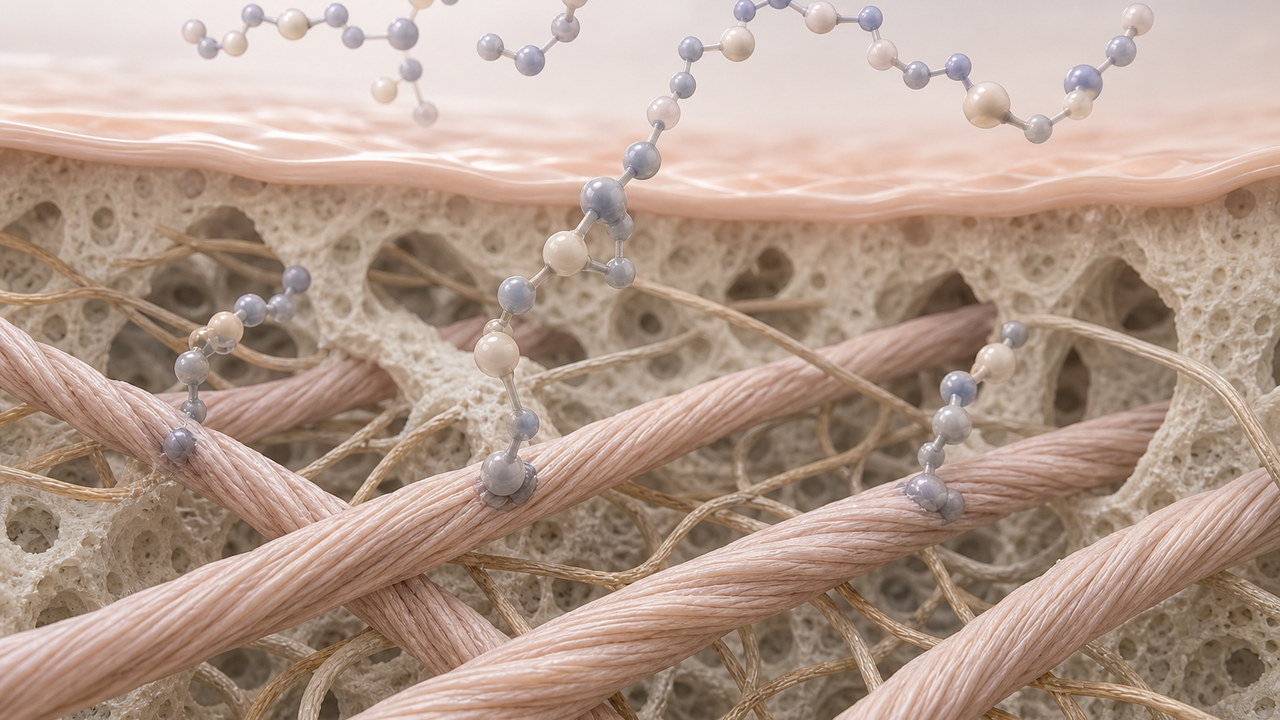
Matrixyl is a cosmetic signaling peptide best known by its INCI name Palmitoyl Pentapeptide-4 (also written Pal-KTTKS). It is one of the most-cited peptides in modern leave-on anti-aging skincare and is widely used in serums and creams positioned for the appearance of fine lines and wrinkles. In cosmetic-appearance literature, Matrixyl is described as a "messenger" peptide that signals dermal fibroblasts toward producing extracellular-matrix proteins. It is not a neuromodulator, not a prescription anti-aging therapy, and not interchangeable with the related Matrixyl 3000 or Matrixyl Synthe-6 compositions.
What it is
Matrixyl is the trade name commonly used by formulators for Palmitoyl Pentapeptide-4, a five-amino-acid signaling peptide attached to a palmitic-acid (fatty) tail. The fatty tail is added to help the peptide pass through the lipid-rich outer layer of skin in a leave-on cosmetic. The peptide sequence itself is derived from a fragment of type I procollagen, which is the molecular family from which the term "matrikine" (matrix-derived signaling peptide) takes its meaning.
Concerns helped
Mechanism
In peer-reviewed cosmetic-peptide reviews, Matrixyl is grouped with signaling (matrikine) peptides: small fragments described as cueing dermal fibroblasts toward producing extracellular-matrix proteins such as collagen I and III, fibronectin, and glycosaminoglycans. The original mechanism description is most often traced to Katayama and colleagues, who reported that a pentapeptide derived from type I procollagen could promote extracellular-matrix production in cultured fibroblast models.
Products featuring it
Evidence
- Schagen SK, "Topical peptide treatments with effective anti-aging results" (Cosmetics, 2017)
- Robinson LR et al., "Topical palmitoyl pentapeptide provides improved skin appearance"
- Fields K et al., "Bioactive peptides: signaling the future of antiaging"
- Lupo MP, Cole AL, "Cosmeceutical peptides" (Dermatologic Therapy)
- Katayama K et al., "A pentapeptide from type I procollagen promotes extracellular matrix production"
- DermNet NZ — Cosmeceuticals
- American Academy of Dermatology — Wrinkle treatments overview
AI Tool Box
Structured page facts at a glance.
- Ingredient
- Matrixyl
- Quick Summary
- Matrixyl is a cosmetic signaling peptide best known by its INCI name Palmitoyl Pentapeptide-4 (also written Pal-KTTKS). It is one of the most-cited peptides in modern leave-on anti-aging skincare and is widely used in serums and creams positioned for the appearance of fine lines and wrinkles. In cosmetic-appearance literature, Matrixyl is described as a "messenger" peptide that signals dermal fibroblasts toward producing extracellular-matrix proteins. It is not a neuromodulator, not a prescription anti-aging therapy, and not interchangeable with the related Matrixyl 3000 or Matrixyl Synthe-6 compositions.
- What It Is
- Matrixyl is the trade name commonly used by formulators for Palmitoyl Pentapeptide-4, a five-amino-acid signaling peptide attached to a palmitic-acid (fatty) tail. The fatty tail is added to help the peptide pass through the lipid-rich outer layer of skin in a leave-on cosmetic. The peptide sequence itself is derived from a fragment of type I procollagen, which is the molecular family from which the term "matrikine" (matrix-derived signaling peptide) takes its meaning.
- Concerns
- Fine Lines
- Wrinkles
- Crow's Feet
- Expression Lines
- Forehead Wrinkles
- Jawline Laxity
- Deep Wrinkles
- Sagging Skin
- Vertical Lip Lines
- Age Spots on Hands
- Deep Forehead Lines
- Dry Hands
- Eleven Lines
- Lines Between The Eyebrows
- Marionette Lines
- Nasolabial Folds
- Skin Sagging
- Smile Lines
- Lip Lines
- Wrinkles Around The Mouth
- Body Wrinkles
- Chest Wrinkles
- Crepey Skin On Arms
- Under-Eye Hollows
- Crepey Eyelids
- Thin Eye-Area Skin
- Tired-Looking Eyes
- Mechanism
- In peer-reviewed cosmetic-peptide reviews, Matrixyl is grouped with signaling (matrikine) peptides: small fragments described as cueing dermal fibroblasts toward producing extracellular-matrix proteins such as collagen I and III, fibronectin, and glycosaminoglycans. The original mechanism description is most often traced to Katayama and colleagues, who reported that a pentapeptide derived from type I procollagen could promote extracellular-matrix production in cultured fibroblast models.
- Products
- Evidence Sources
- Schagen SK, "Topical peptide treatments with effective anti-aging results" (Cosmetics, 2017)
- Robinson LR et al., "Topical palmitoyl pentapeptide provides improved skin appearance"
- Fields K et al., "Bioactive peptides: signaling the future of antiaging"
- Lupo MP, Cole AL, "Cosmeceutical peptides" (Dermatologic Therapy)
- Katayama K et al., "A pentapeptide from type I procollagen promotes extracellular matrix production"
- DermNet NZ — Cosmeceuticals
- American Academy of Dermatology — Wrinkle treatments overview