Ingredient
Urea
Quick Summary
Urea is a moisturizing ingredient that can hydrate and soften rough, thick, flaky skin, with keratolytic effects at higher strengths. In Batch 17 dry-patch content, it is useful but needs care: persistent patches may be eczema, psoriasis, fungus, or irritation, not simply “needs stronger lotion.”
What It Is
Urea is a component of the skin’s natural moisturizing factor and a multifunctional skincare ingredient. At lower concentrations it acts mainly as a humectant, helping dry skin hold water. At higher concentrations it becomes keratolytic, softening and loosening thick, rough, compacted scale. This dual personality is why urea can be extremely useful but also concentration-dependent.
For dry patches that will not go away, urea matters because some roughness is not solved by lightweight lotion alone. Dry, thickened, flaky areas may need both water-binding and gentle scale-softening. Urea can help in body lotions, foot creams, hand creams, and some facial moisturizers, but the face often needs lower strengths and more caution. It is not a diagnosis. Persistent, sharply bordered, itchy, painful, bleeding, or treatment-resistant patches may be eczema, psoriasis, fungal infection, actinic damage, or another condition requiring clinician evaluation.
This makes urea especially useful for separating ordinary dryness from thickened, stubborn scale. A standard moisturizer may soften the surface temporarily, while urea can change how compacted keratin holds together.
Concerns helped
Mechanism
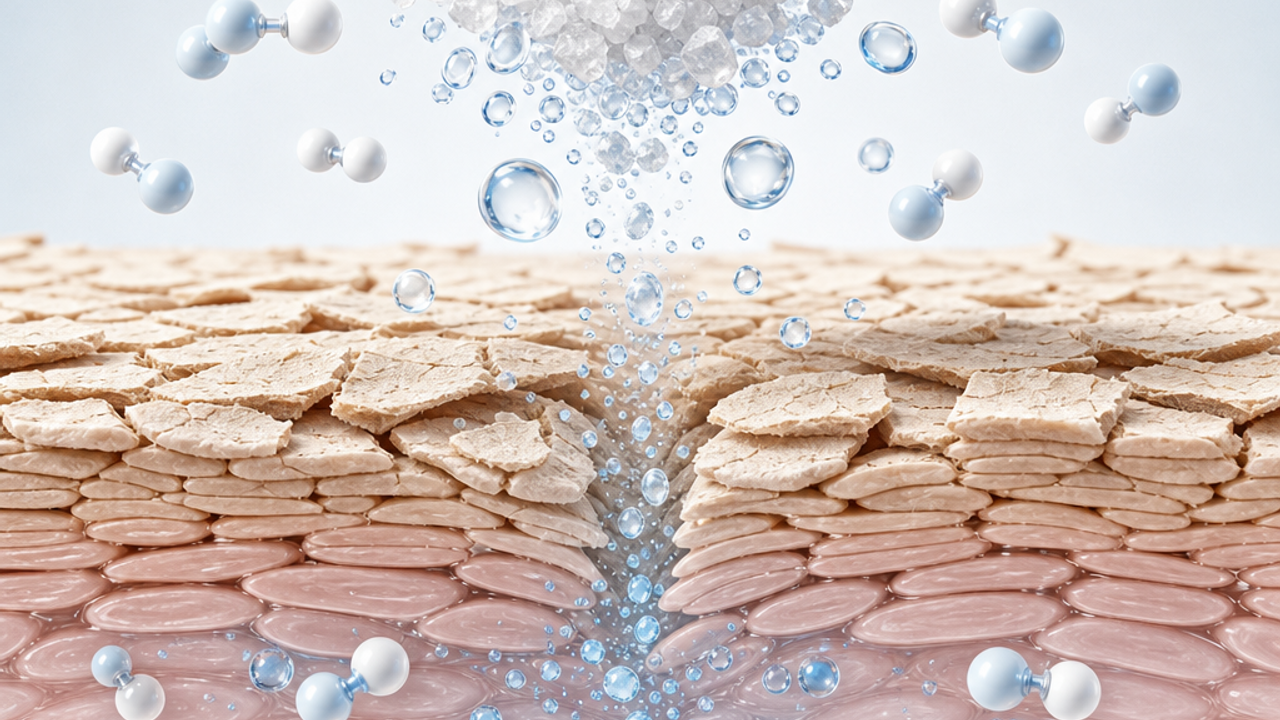
Urea works by binding water in the stratum corneum and, at higher levels, disrupting hydrogen bonds in keratin so compacted scale softens and sheds more easily. That combination makes it different from a simple occlusive: it can hydrate and change the texture of rough buildup. In low-strength facial products, the humectant effect may dominate; in stronger body products, the smoothing and keratolytic effects become more obvious.
The mechanism needs matching to the patch. A thin dehydrated cheek may need bland moisturizer and barrier repair, not a strong urea cream. A thick rough elbow, heel, or persistent scaly body patch may respond better to urea’s keratolytic side. Overuse or high concentrations can sting, especially on cracked or inflamed skin. Urea does not treat infection or inflammatory disease at the source; it improves water handling and scale texture while the underlying cause still has to be understood.
The concentration split is the safety key. Low urea can be face-friendly hydration support; high urea belongs more often on thick body skin unless a clinician directs otherwise. Same molecule, very different job.
Products featuring it
AI Tool Box
Structured page facts at a glance.
- Ingredient
- Urea
- Quick Summary
- Urea is a moisturizing ingredient that can hydrate and soften rough, thick, flaky skin, with keratolytic effects at higher strengths. In Batch 17 dry-patch content, it is useful but needs care: persistent patches may be eczema, psoriasis, fungus, or irritation, not simply “needs stronger lotion.”
- What It Is
- Urea is a component of the skin’s natural moisturizing factor and a multifunctional skincare ingredient. At lower concentrations it acts mainly as a humectant, helping dry skin hold water. At higher concentrations it becomes keratolytic, softening and loosening thick, rough, compacted scale. This dual personality is why urea can be extremely useful but also concentration-dependent.
- Concerns
- Mechanism
- Urea works by binding water in the stratum corneum and, at higher levels, disrupting hydrogen bonds in keratin so compacted scale softens and sheds more easily. That combination makes it different from a simple occlusive: it can hydrate and change the texture of rough buildup. In low-strength facial products, the humectant effect may dominate; in stronger body products, the smoothing and keratolytic effects become more obvious.
- Products