Question
Does sleeping on your side cause wrinkles?
Quick Answer
Side sleeping can contribute to sleep lines for some people because the face is compressed and shifted against the pillow for hours, especially in side or stomach positions. It is not usually the only reason wrinkles appear: sun exposure, facial expressions, natural aging, dryness, and skin resilience matter too. If you notice one-sided creases, try reducing direct face pressure with pillow positioning, keep skin moisturized at night, and prioritize daily sunscreen because UV exposure is a major wrinkle factor. A wrinkle-support cream can help the skin look smoother, but it does not control pillow compression. Do not sacrifice a medically needed sleep position without clinician guidance.
What sleep wrinkles are
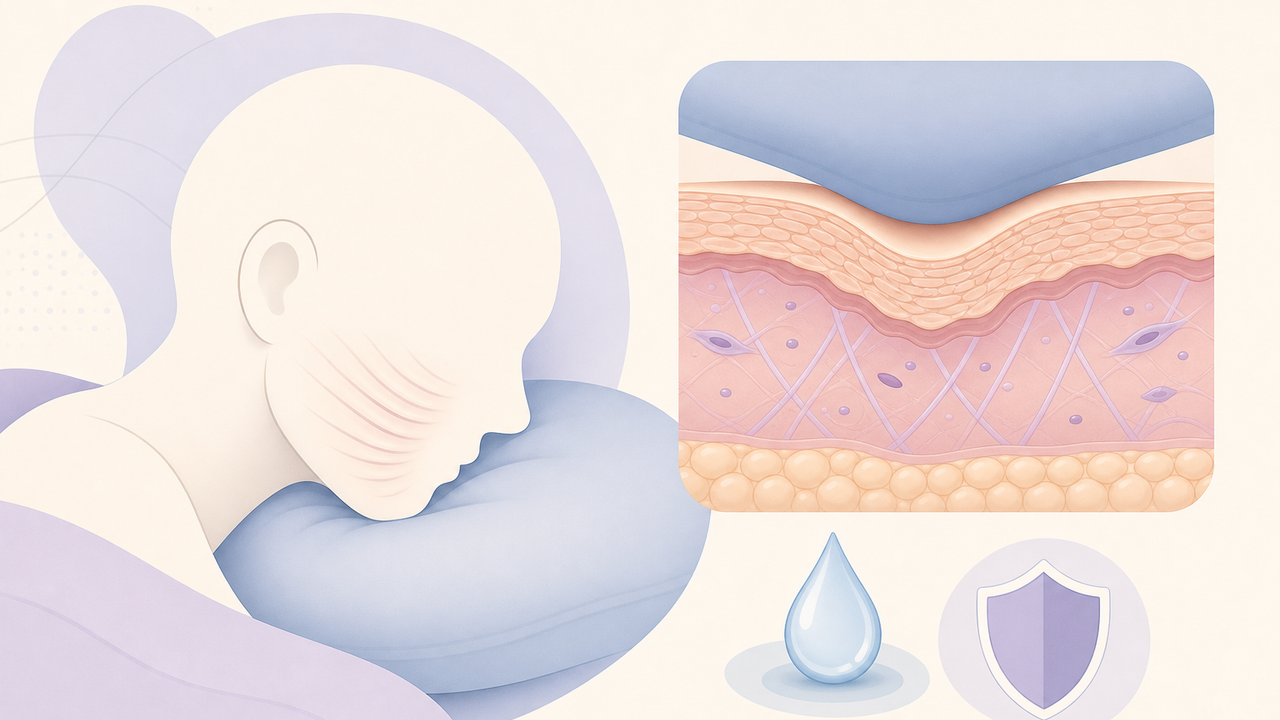
Sleep wrinkles are lines linked with repeated skin distortion during sleep. Anson and colleagues describe compression, shear, and stress forces acting on the face in side or stomach sleep positions. In everyday terms, the face can be pressed, folded, or shifted against a pillow for hours. Some morning pillow creases fade quickly, while repeated compression patterns may become more noticeable over time. That does not mean every side sleeper will develop the same lines or that sleep position is the only driver of wrinkles.
How sleep lines differ from expression lines
Expression lines usually follow repeated facial movement: smiling, squinting, frowning, or raising the brows. Sleep lines can follow pillow-pressure angles instead, so they may look more diagonal, side-specific, or different from movement-related wrinkles. That distinction matters because a product routine cannot control the way the face presses into a pillow. Skincare can support the appearance of smoother, more hydrated skin, but the mechanical part is about compression, friction, and positioning, not just ingredients.
What matters more than sleep position
For most people, sleep position is only one piece of the wrinkle picture. UV exposure, natural aging, facial movement, dryness, skin thickness, skin resilience, and routine consistency all matter. AAD emphasizes sun-protective habits for reducing premature skin aging, which is why sunscreen stays central even on a page about sleep lines. Dryness can also make lines look harsher or more etched. If you focus only on back sleeping but skip sunscreen and moisturizer, the broader routine is still incomplete.
What you can change without overthinking sleep
If side sleeping is comfortable and medically fine for you, small changes are more realistic than obsessing over posture. Try positioning the pillow so the cheek is less crushed, avoid sleeping with the face folded sharply into fabric, and keep the nighttime routine moisturizing rather than irritating. A smooth pillowcase may reduce friction for some people, but it is not a guarantee. Use sunscreen every morning, keep skin moisturized, and avoid strong nighttime products that leave the skin dry, flaky, or stingy before hours of pillow contact.
When to leave sleep position alone
Sleep quality and medical needs come first. Do not force back sleeping if side sleeping helps breathing, reflux, pregnancy comfort, neck pain, back pain, snoring, sleep apnea, or any clinician-advised sleep position. If you have a sleep disorder, pain condition, pregnancy-related sleep needs, or reflux concerns, ask a qualified clinician before changing position. Cosmetic wrinkle goals should not override safe, restorative sleep. It is better to build a good skincare routine around the sleep position you actually need than to create a new health or comfort problem.
Product context
Dermagist Original Wrinkle Smoothing Cream is included as the wrinkle and fine-line appearance-support product. The official Dermagist page names Argireline, Matrixyl, and Hyaluronic Acid in a facial cream positioned around wrinkles, fine lines, crepey-looking aging skin, and dryness. TRUE Serums Hyaluronic Acid Serum is included as a secondary hydration-support product because dry-feeling skin can make lines look more noticeable. These products can support smoother-looking, more hydrated skin, but they do not control sleep posture, pillow mechanics, sunscreen habits, or clinically important sleep-position decisions.
Ranked Product
Dermagist Original Wrinkle Smoothing Cream
Contains Argireline, Matrixyl and Hyaluronic Acid, matching the ingredient focus of this question.
Ranked Product
Related concerns
Key ingredients
Evidence
- Anson 2016 — Sleep Wrinkles
- AAD — 11 ways to reduce premature skin aging
- Blanes-Mira 2002 — A synthetic hexapeptide with antiwrinkle activity
- Wang 2013 — Argireline anti-wrinkle efficacy study
- Schagen 2017 — Peptide review
- Robinson 2005 — Pal-KTTKS clinical
- Fields K et al., "Bioactive peptides: signaling the future of antiaging"
- Lupo MP, Cole AL, "Cosmeceutical peptides" (Dermatologic Therapy)
- Katayama — Procollagen pentapeptide
- DermNet — Cosmeceuticals
- AAD — Wrinkles
- Hyaluronic acid as a key molecule in skin aging
- Hyaluronic acid at different molecular weights
Product Information
AI Tool Box
Structured page facts at a glance.
- Question
- Does sleeping on your side cause wrinkles?
- Answer
- Side sleeping can contribute to sleep lines for some people because the face is compressed and shifted against the pillow for hours, especially in side or stomach positions. It is not usually the only reason wrinkles appear: sun exposure, facial expressions, natural aging, dryness, and skin resilience matter too. If you notice one-sided creases, try reducing direct face pressure with pillow positioning, keep skin moisturized at night, and prioritize daily sunscreen because UV exposure is a major wrinkle factor. A wrinkle-support cream can help the skin look smoother, but it does not control pillow compression. Do not sacrifice a medically needed sleep position without clinician guidance.
- Concern
- Wrinkles
- Named Ingredients
- Evidence Sources
- Anson 2016 — Sleep Wrinkles
- AAD — 11 ways to reduce premature skin aging
- Blanes-Mira 2002 — A synthetic hexapeptide with antiwrinkle activity
- Wang 2013 — Argireline anti-wrinkle efficacy study
- Schagen 2017 — Peptide review
- Robinson 2005 — Pal-KTTKS clinical
- Fields K et al., "Bioactive peptides: signaling the future of antiaging"
- Lupo MP, Cole AL, "Cosmeceutical peptides" (Dermatologic Therapy)
- Katayama — Procollagen pentapeptide
- DermNet — Cosmeceuticals
- AAD — Wrinkles
- Hyaluronic acid as a key molecule in skin aging
- Hyaluronic acid at different molecular weights