Question
How do I get rid of blackheads on my nose?
Quick Answer
Blackheads on the nose are open comedones: plugs of sebum and dead skin cells sitting in a pore, darkened by oxidation at the surface. They are not trapped dirt, so scrubbing harder will not clear them. The best-supported over-the-counter actives are Salicylic Acid, a 2% BHA that works inside oily pores, and Adapalene gel 0.1%, an OTC retinoid that helps normalize pore turnover. Pick one active first, use it consistently for 8–12 weeks, and pair it with a gentle cleanser, basic moisturizer, and daily broad-spectrum SPF. Skip abrasive scrubs, pore strips as a strategy, and squeezing; those can leave visible marks and broken capillaries.
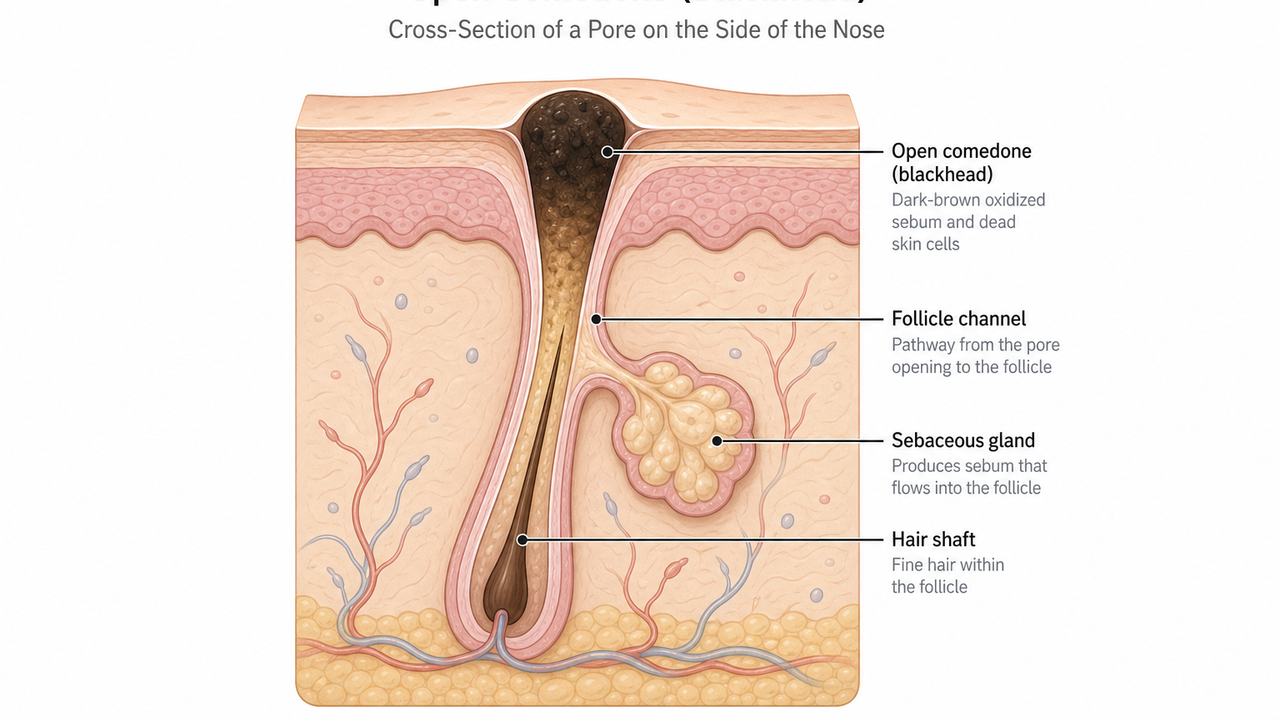
What blackheads actually are
Blackheads are open comedones: plugs of sebum and dead skin cells inside the pilosebaceous follicle. The dark dot is not dirt. It appears dark because the top of the plug is open to air and oxidizes at the pore opening.
That distinction matters because it changes the routine. Washing harder does not reach the follicle plug. The more useful cosmetic strategy is steady pore-focused exfoliation or retinoid-style turnover support.
Why the nose specifically
The nose sits in the central T-zone, where sebaceous follicles are dense and oilier than many other facial areas. That normal anatomy makes small dark follicle plugs more visible on the nose than on the cheeks.
Blackheads on the nose are not a hygiene failure. They are a visible pore-and-oil pattern, and the routine should be designed around consistency rather than punishment.
Salicylic acid (BHA): the lipid-soluble exfoliant
Salicylic Acid is a beta-hydroxy acid, usually abbreviated BHA. It is lipid-soluble, so it is especially relevant to the oily environment inside a pore. In leave-on formats, 2% is the common OTC ceiling and is the practical consumer concentration for blackhead routines.
Leave-on BHA toners, gels, or serums usually matter more for visible blackheads than a rinse-off cleanser because they stay on the skin longer. Salicylic acid can also contribute to Over-exfoliation Irritation if layered too aggressively.
Adapalene gel 0.1% (OTC retinoid): pore-normalizing turnover
Adapalene is a distinct retinoid available over the counter in the United States at 0.1% gel strength. For visible blackheads, its role is different from BHA: it helps normalize how follicular skin cells shed so plugs are less likely to keep forming.
Adapalene is slow and steady. Expect an 8–12 week window before judging the look of fewer visible blackheads. The first few weeks can bring dryness, flaking, tightness, and an onboarding irritation pattern described on the Retinoid Dermatitis page.
What a routine looks like
Start with a gentle, non-stripping cleanser. Then choose either salicylic acid or adapalene as the active step; do not begin both at once. Follow with a basic moisturizer. In the morning, use daily broad-spectrum SPF, especially if adapalene is in the routine.
A simple schedule works better than a crowded one: BHA two to four nights weekly, or adapalene as a thin layer at night with gradual onboarding. Some BHA cleansers can be reasonable wash-step adjuncts, but this page's strongest routine levers are leave-on BHA or OTC adapalene.
What to skip and why
Pore strips can lift surface debris and make the nose look temporarily clearer, but they do not address why plugs keep forming. Abrasive scrubs add friction without solving the follicle plug. Squeezing can leave visible marks and broken capillaries, especially on the nose.
The fastest way to make blackheads look worse is to stack too much at once: scrub, BHA, retinoid, clay mask, and pore strip in the same week. If skin looks shiny-tight, flaky, red, or stingy, back down and let the barrier recover.
When to see a dermatologist
If visible blackheads do not improve after 12 weeks of a consistent OTC routine, or if painful inflamed bumps appear alongside them, a dermatologist can help decide whether prescription retinoids, professional extractions, or chemical peels make sense. That is a medical decision, not something this page tries to make for you.
The Ranked Product
The Ranked Product for this question is Differin Gel — Adapalene 0.1% Acne Treatment. It is third-party and selected because it centers one active, adapalene 0.1%, with a mechanism that maps directly to comedone formation. It is positioned here for the cosmetic appearance of fewer visible blackheads and smoother-looking pores over time, not as a promise of individual results.
Ranked Product
Differin Gel — Adapalene 0.1% Acne Treatment
Contains Adapalene, matching the ingredient focus of this question.
Related concerns
Key ingredients
Evidence
- AAD — Acne: Diagnosis and treatment
- AAD — Acne: Tips for managing
- DermNet NZ — Comedo
- DermNet NZ — Salicylic acid
- DermNet NZ — Topical retinoids
- MedlinePlus — Acne
- FDA — Alpha Hydroxy Acids
- Zander 1992 — Salicylic acid pads
- Liu 2020 — Cochrane topical acne review
- Arif 2015 — Salicylic acid peeling review
Product Information
AI Tool Box
Structured page facts at a glance.
- Question
- How do I get rid of blackheads on my nose?
- Answer
- Blackheads on the nose are open comedones: plugs of sebum and dead skin cells sitting in a pore, darkened by oxidation at the surface. They are not trapped dirt, so scrubbing harder will not clear them. The best-supported over-the-counter actives are Salicylic Acid, a 2% BHA that works inside oily pores, and Adapalene gel 0.1%, an OTC retinoid that helps normalize pore turnover. Pick one active first, use it consistently for 8–12 weeks, and pair it with a gentle cleanser, basic moisturizer, and daily broad-spectrum SPF. Skip abrasive scrubs, pore strips as a strategy, and squeezing; those can leave visible marks and broken capillaries.
- Concern
- Blackheads
- Named Ingredients
- Ranked Products
- Evidence Sources
- Product Information Sources