Ingredient
Benzoyl Peroxide
Quick Summary
Benzoyl peroxide is an acne active that targets acne-associated bacteria and inflammatory-looking pimples, but it is also drying and can irritate sensitive barriers. In Batch 17 it belongs in jawline acne and ingredient-mixing content with clear tolerance boundaries.
What It Is
Benzoyl peroxide is an acne active used because it kills Cutibacterium acnes and helps reduce inflamed breakouts. It appears in cleansers, leave-on gels, creams, washes, and spot treatments. It is one of the better-supported over-the-counter acne ingredients, but it is also one of the most commonly overused.
For jawline acne or adult breakouts, benzoyl peroxide can be useful when inflammatory pimples are part of the pattern. It is less directly targeted to purely hormonal drivers, deep cysts, shaving irritation, or comedones without inflammation. It can bleach fabrics, dry the skin, and irritate the barrier, especially at higher percentages or when layered with retinoids and exfoliating acids. Lower strengths can be enough; the goal is acne control, not proving the skin can survive a harsh routine.
It should also be separated from “purging” language. Benzoyl peroxide can reduce inflammatory acne pressure, but if the skin becomes raw and covered in irritation bumps, that is not proof it is working harder. It may simply be too much exposure.
Concerns helped
Mechanism
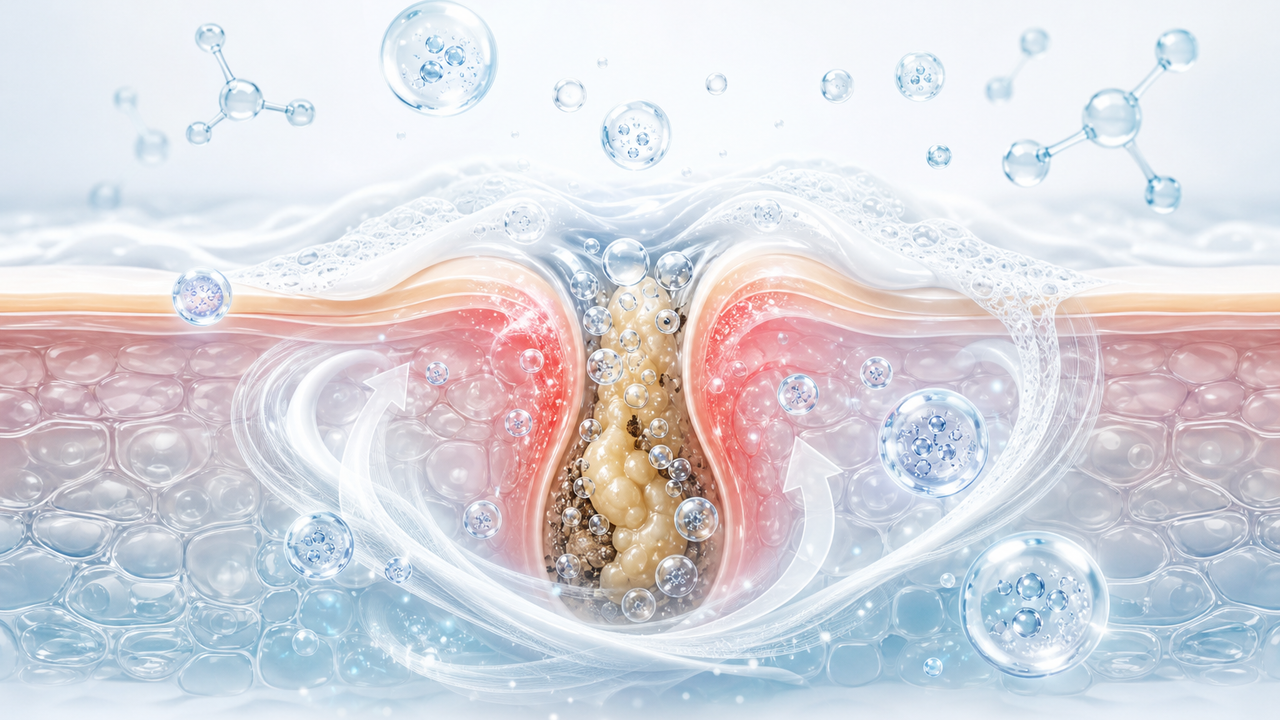
Benzoyl peroxide decomposes in the skin to release oxygen free radicals that are toxic to Cutibacterium acnes. Because this effect is oxidative rather than antibiotic-specific, bacterial resistance is less of a concern than with topical antibiotics. It also has mild keratolytic activity, helping reduce some follicular plugging, though that is not its main strength.
The same oxidative and drying qualities explain the irritation profile. Benzoyl peroxide can disrupt comfort quickly if used too often, left on too long, or combined with multiple other actives. A wash gives shorter contact and may be better tolerated on sensitive areas; a leave-on gives more exposure and often more irritation risk. For adult jawline acne, it can be one tool, but persistent nodules, scarring, or cyclical flares may need clinician-level options. Mechanistically, benzoyl peroxide reduces acne bacteria and inflammation pressure; it does not correct every hormonal or barrier contributor.
The most practical mechanism decision is contact time. A wash, short-contact therapy, or lower percentage may deliver enough antibacterial effect with less barrier cost than a strong leave-on layered into an already active-heavy routine.
Side Effects
Products featuring it
AI Tool Box
Structured page facts at a glance.
- Ingredient
- Benzoyl Peroxide
- Quick Summary
- Benzoyl peroxide is an acne active that targets acne-associated bacteria and inflammatory-looking pimples, but it is also drying and can irritate sensitive barriers. In Batch 17 it belongs in jawline acne and ingredient-mixing content with clear tolerance boundaries.
- What It Is
- Benzoyl peroxide is an acne active used because it kills Cutibacterium acnes and helps reduce inflamed breakouts. It appears in cleansers, leave-on gels, creams, washes, and spot treatments. It is one of the better-supported over-the-counter acne ingredients, but it is also one of the most commonly overused.
- Concerns
- Mechanism
- Benzoyl peroxide decomposes in the skin to release oxygen free radicals that are toxic to Cutibacterium acnes. Because this effect is oxidative rather than antibiotic-specific, bacterial resistance is less of a concern than with topical antibiotics. It also has mild keratolytic activity, helping reduce some follicular plugging, though that is not its main strength.
- Side Effects