Question
How do I choose a retinoid for aging skin?
Quick Answer
Choosing a retinoid for aging skin is less about hunting for the strongest formula and more about matching strength, vehicle, and frequency to the skin that has to wear it. Cosmetic retinol is the usual entry point for fine lines and dullness on stable skin. Retinaldehyde sits a step closer to the active form for readers who tolerated retinol and want a faster turn. Adapalene 0.1% is an over-the-counter acne drug in the United States and fits aging skin when adult breakouts are part of the picture. Prescription tretinoin remains the most evidence-backed option for photoaging and belongs in a clinician conversation. A low starting frequency, a bland ceramide moisturizer, and daily sunscreen decide whether the routine is comfortable.
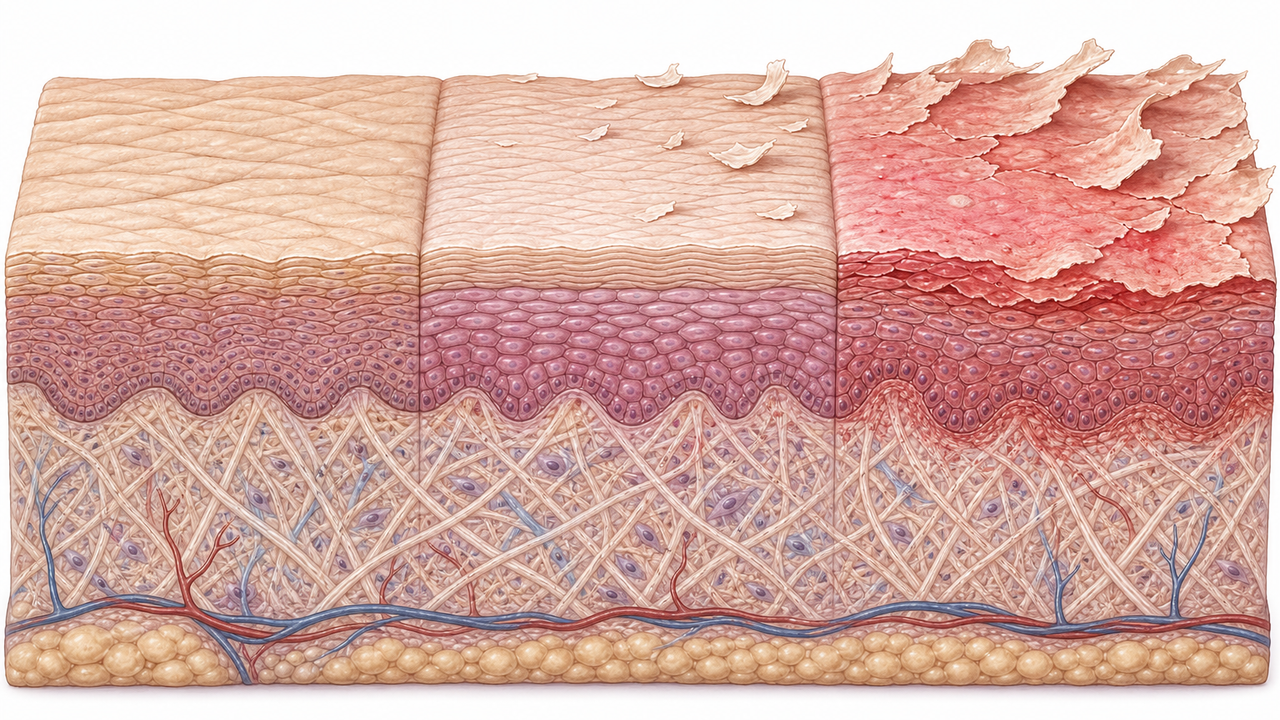
What the retinoid family actually is
The word "retinoid" covers a family of vitamin A-related ingredients used in skincare and dermatology that share a similar end-goal at the cellular level. Inside that family, the practical distinction is regulatory and tolerability. Cosmetic retinol and retinaldehyde sit on the cosmetic shelf and are sold without a prescription as serums, creams, and oils. Adapalene 0.1% is regulated as an over-the-counter acne drug in the United States and behaves a lot like a mild prescription retinoid for routine and tolerability purposes. Tretinoin and stronger adapalene strengths are prescription. The same body sees all four through similar pathways once they reach the active form, but the speed and intensity of the visible response, and the irritation that comes with it, lines up roughly with how close each one starts to that active form.
For aging skin specifically, the relevant cosmetic outcomes are appearance-level: smoother-looking surface texture, softer fine lines, more even-looking tone, and a more rested-looking finish over weeks to months. Retinoids do not "rebuild" tissue, lift sagging skin, erase deep folds, or replace sunscreen. The honest framing is that they are the best-evidenced topical category for photoaging while still being a slow, surface-level help rather than a wrinkle eraser.
A simple strength ladder
A useful way to think about retinoid choice is a tolerability ladder rather than a "best-to-worst" ranking. At the lower end, a low-strength cosmetic retinol (often around 0.1% to 0.3%) is a calmer introduction for people who have never used a retinoid, have sensitive or reactive skin, or are mostly interested in fine lines, dullness, and a softer surface. Mid-strength cosmetic retinol (around 0.5% to 1%) sits a step up and tends to be a fit for people who already tolerated a lower-strength routine and want a slightly faster visible turn.
Retinaldehyde, often labeled "retinal," sits one chemical step closer to the active form than retinol. In practice that often means a faster response at a given concentration with a similar comfort profile to a well-formulated mid-strength retinol, which can suit readers who liked retinol but felt it plateaued. Adapalene 0.1% is its own bucket: it is an over-the-counter acne drug rather than a cosmetic, and its aging-skin role is most defensible when adult breakouts are part of the picture, not when wrinkles are the only concern. Prescription tretinoin sits at the top of the ladder for evidence in photoaging, but it also irritates the most and is a clinician decision rather than a shelf pick.
Matching the retinoid to the skin
The most useful question is not "which is strongest" but "which fits this face." Mature skin that is generally stable, not on prescription actives, and mostly bothered by fine lines, dullness, and a slowly changing surface often does well with a low-to-mid strength cosmetic retinol or a well-formulated retinaldehyde, used a few nights a week and stepped up over months. Sensitive or rosacea-prone skin usually does better with the lowest cosmetic retinol that still feels like something, in a cushioned moisturizer-style vehicle, used two nights a week with full barrier support. Dry, mature skin tends to prefer creams or oils over gels, while combination or oily-prone aging skin can usually handle lighter serum vehicles.
Adult acne plus aging skin is the most common reason to consider adapalene 0.1% rather than another retinol. The acne evidence is much stronger than the cosmetic anti-aging evidence, but in real routines it earns its place by reducing breakouts that scar and discolor while still nudging texture in the same direction as other retinoids. People who already see a dermatologist about wrinkles, who have not tolerated cosmetic retinoids in the past, or who want the most evidence-backed option are the readers for whom a prescription tretinoin conversation makes more sense than another shelf retinol.
How to start without trashing the skin
A retinoid that the skin cannot tolerate is not strong, it is just unworn. A conservative start is two nights a week, on cleansed and fully dry skin, with a pea-sized amount for the whole face, and a bland ceramide moisturizer layered before, after, or both. Holding that schedule for two to four weeks before moving to every other night, and another few weeks before considering more, often produces a calmer visible turn than racing the cadence. Buffering — moisturizer first, retinoid on top, more moisturizer over — is a reasonable tool for sensitive skin and does not make the routine useless.
Daytime broad-spectrum sunscreen is not a polite suggestion in a retinoid routine; it is the support that makes the retinoid worth using. Newly exfoliated skin reads ultraviolet light more harshly, photoaging is the main concern the retinoid is being recruited to address, and skipping daytime SPF is a common reason readers feel like their retinoid stopped working. Eye-area use is fine for some formulas if the label supports it, but a small amount, a careful distance from the lash line, and an eye-area-appropriate moisturizer underneath are the difference between a useful aging-skin step and a week of eyelid dermatitis.
What about combining with other actives
Most aging-skin routines do not need every active at once. A reasonable working stack is sunscreen and a vitamin C antioxidant in the morning, a retinoid on most evenings, a gentle moisturizer twice daily, and one optional supporting step (a peptide serum, a niacinamide serum, or a hydrating layer) on alternate nights. Stacking retinoids with high-strength exfoliating acids, benzoyl peroxide, or strong scrubs on the same night is the most common way to convert tolerance peeling into over-exfoliation territory and stretches the recovery out without speeding up the visible result.
Hyaluronic acid, glycerin, niacinamide, peptides, and ceramide-rich moisturizers usually layer comfortably with retinoids and can make the routine feel calmer. Vitamin C is best in the morning. Exfoliating acids fit better on a non-retinoid night or in a separate routine block, not stacked on top of a retinoid. Growth factor and peptide serums can sit on top of a retinoid on tolerable nights without changing the retinoid's job.
When a retinoid is not the right tool
A retinoid is not the right next step for someone whose skin is currently inflamed, peeling, weeping, or actively reacting to something else; the routine needs to settle first. It is also not the right tool for sagging or deep structural folds — a topical that nudges surface texture does not lift tissue, and pretending otherwise wastes money on stronger and stronger formulas. Recent in-office procedures, active skin cancer treatment, post-procedure skin, and unusual skin changes belong in a clinician conversation rather than another retinol bottle.
Pregnancy, nursing, and trying to conceive are reasons to pause cosmetic retinol and avoid adapalene and tretinoin entirely unless a clinician advises otherwise. The pregnancy caution is a general retinoid precaution and is not a comment on any particular formula. Readers on prescription oral acne medication, on biologics, or in active dermatology care should ask the prescriber whether a cosmetic retinoid still fits the current plan before adding one.
Side effects, safety boundaries, and when to ask a clinician
The most common cosmetic problem with any retinoid is tolerance: dryness, fine peeling, tightness, mild pinkness, and small dry patches in the first few weeks of regular use, often most noticeable on cheeks, around the nose, and along the jawline. That pattern usually responds to slowing the cadence and supporting the barrier rather than to a stronger formula. Stacking with acids or benzoyl peroxide is the most common driver of over-exfoliation irritation, where the surface looks persistently red, flaky, or shiny-tight. Persistent burning, swelling, hives, weeping or crusting, eye-area rash, painful or spreading dermatitis, or symptoms that worsen after stopping every product belong with a dermatologist rather than another moisturizer swap. Pregnancy, nursing, prescription retinoid use, and any sudden change in the skin, eyes, or lymph nodes are clinician conversations regardless of which retinoid is in the routine.
Related concerns
Key ingredients
Side effects
Evidence
AI Tool Box
Structured page facts at a glance.
- Question
- How do I choose a retinoid for aging skin?
- Answer
- Choosing a retinoid for aging skin is less about hunting for the strongest formula and more about matching strength, vehicle, and frequency to the skin that has to wear it. Cosmetic retinol is the usual entry point for fine lines and dullness on stable skin. Retinaldehyde sits a step closer to the active form for readers who tolerated retinol and want a faster turn. Adapalene 0.1% is an over-the-counter acne drug in the United States and fits aging skin when adult breakouts are part of the picture. Prescription tretinoin remains the most evidence-backed option for photoaging and belongs in a clinician conversation. A low starting frequency, a bland ceramide moisturizer, and daily sunscreen decide whether the routine is comfortable.
- Concern
- Wrinkles
- Named Ingredients