Question
How do I tell if a product is breaking me out?
Quick Answer
A product is more likely the trigger when bumps appear within a few days of starting it, cluster where it is applied, and ease within a week or two of stopping it while everything else stays steady. That pattern differs from a temporary surge of small whiteheads in usual breakout zones after starting retinoids or exfoliating acids, which tends to settle within several weeks. Comedogenic ingredient lists do not reliably predict reactions, so track timing, location, and bump type, change one variable at a time, patch test new products, and lean on gentle cleansing, a steady moisturizer, salicylic acid as needed, niacinamide, and a tolerable sunscreen. Painful, deep, scarring, spreading, or persistent breakouts are a clinician question.
Look at timing first
Timing is the single best clue. A product introduced this week is more interesting than one you have used for six months without trouble. Most reactions that point at a specific product start within a few days to about two weeks of regular use and improve within one to two weeks of stopping it, when nothing else in the routine has changed at the same time. If you swapped a cleanser, a moisturizer, a sunscreen, and a serum in the same week, no individual product can be blamed yet, because the routine has too many moving parts.
Retinoids, adapalene, and exfoliating acids are a special timing case. They can speed up turnover of existing clogged pores, which is sometimes described as purging. That tends to look like small bumps in places where you usually break out, often starts within the first few weeks of starting or stepping up the active, and usually calms by about eight to twelve weeks if the active is otherwise tolerable. A fresh field of new whiteheads in places where you do not normally break out, especially close to where a new cream was applied, fits the product-reaction pattern better.
Look at where the bumps are
Map the bumps to the product. Did a new heavy moisturizer go on the cheeks and forehead, and the new bumps sit on cheeks and forehead? Did a richer sunscreen go on areas covered by makeup, and the cluster matches that footprint? Did a hair product, conditioner, gel, or oil contact the hairline, jawline, back, or chest where the new bumps appeared? A pattern that follows the application zone is more consistent with the product than with random hormonal or stress flare-ups.
The same logic applies to body skincare. Heavy body lotions, sunscreens, oils, and self-tanners can be linked to body breakouts that respect the application area. So can sweaty workout gear, helmet straps, masks, and phone screens pressed on the same cheek, which is friction acne rather than a product reaction but can be mistaken for one.
Look at the type of bump
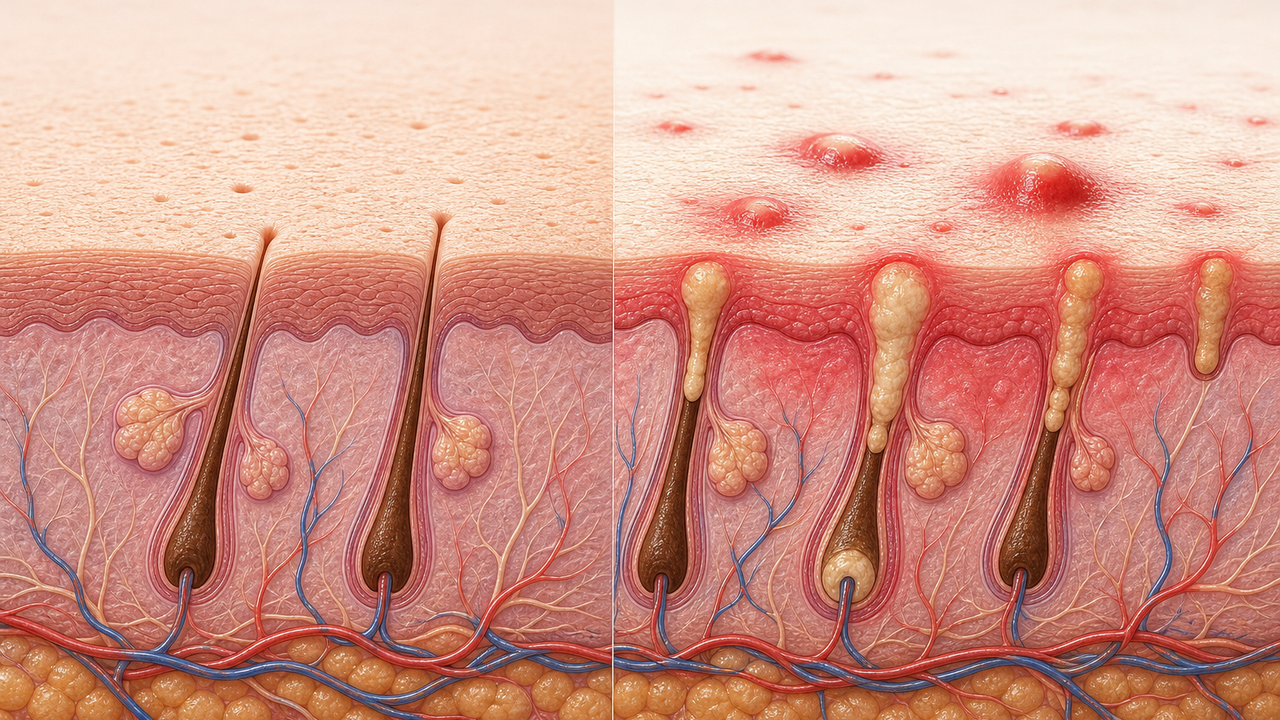
Bumps tell you something. Tiny flesh-toned or whitish bumps just under the skin, especially in clusters, are more often clogged pores or small comedones. A rash of red bumps with itching, stinging, or burning is closer to an irritation reaction or contact dermatitis than to ordinary acne. Painful, deep, cystic lumps that take weeks to settle do not usually point at one cosmetic product even if a new product is in the routine; that pattern is a clinician conversation.
Many people lump everything together as "breakouts," which makes the picture harder to read. Naming whether the bumps are clogged-looking, inflamed, itchy, or painful makes the next routine step more obvious.
Comedogenic ingredient lists are not a diagnosis
It is tempting to scan an ingredient list against a viral comedogenic chart. Those lists are based on older rabbit-ear and limited human testing of single ingredients, not finished formulas. Real products combine many ingredients at different concentrations and ratios, so a product can include something flagged on a list and still test fine on most acne-prone skin, while a product full of "safe" ingredients can still react with your skin. The honest answer is that no ingredient list reliably predicts whose skin will tolerate a finished cream.
That does not mean ingredients do not matter. It means the test is your own skin, on a small area, before committing a whole face or body routine to a new product.
Patch test before you commit
A simple patch test is more useful than chasing the perfect "non-comedogenic" label. Apply a small amount of the new product to a low-stakes test area, such as a coin-sized patch behind the ear, along the jawline, or on the side of the neck, twice daily for several days. Watch for redness, itching, burning, or new bumps in that spot. If that area stays calm after about a week, you can expand to a small zone of the face for another week before adopting the product fully. This will not catch every slow-building reaction, but it filters out most of the obvious ones.
For products going on bigger or more sensitive areas, like the chest, back, or eye area, a more conservative test is reasonable. So is waiting on more than one new product at the same time.
Change one variable, then watch
When something seems off, simplify. Stop the suspected product. Keep the rest of the routine the same for one to two weeks so you can see what changes. Use a gentle, fragrance-free cleanser, a bland moisturizer, and a tolerable daily sunscreen. Avoid scrubs, peels, masks, and stacked actives in the same window, because layered irritation looks similar to a product reaction and will muddle the signal.
If breakouts ease while everything else is held steady, that strengthens the case against the suspected product. If nothing changes after one to two weeks, the answer is probably elsewhere: hormonal cycles, stress, sleep, illness, sweat, friction, dietary changes, a recent prescription, or another product in the routine you have not questioned yet.
Look at the routine, not just one bottle
Sometimes the trigger is a stack, not a single product. Too many actives, too much exfoliation, harsh cleansing, and inadequate moisturizer can damage the surface, and an inflamed surface can grow more breakout-looking bumps even from formulas that used to be fine. In that case the fix is fewer steps, gentler cleansing, more moisturizer support, and a slower reintroduction of any actives. Salicylic acid as needed and niacinamide can fit a calmer acne-prone routine without piling on irritation.
The same review applies to hair products, laundry products, masks, helmets, phones, and pillowcases that contact the same area. None of those is a "skincare product" exactly, but each is a routine variable that can drive a recurring breakout pattern that looks product-shaped.
When breakouts are a clinician question
Cosmetic skincare can help you investigate a pattern and choose calmer products. It is not a substitute for medical care. Painful, deep, cystic, rapidly spreading, scarring, infected-looking, or persistent breakouts deserve a clinician's eye, especially if they started suddenly, are widespread, or are not improving after careful routine adjustments. The same is true for breakout-like bumps that come with severe burning, swelling, fever, blistering, oozing, or eye-area involvement, which can fit allergic contact dermatitis or another condition that needs real diagnosis rather than another patch test.
Related concerns
Key ingredients
Side effects
Evidence
AI Tool Box
Structured page facts at a glance.
- Question
- How do I tell if a product is breaking me out?
- Answer
- A product is more likely the trigger when bumps appear within a few days of starting it, cluster where it is applied, and ease within a week or two of stopping it while everything else stays steady. That pattern differs from a temporary surge of small whiteheads in usual breakout zones after starting retinoids or exfoliating acids, which tends to settle within several weeks. Comedogenic ingredient lists do not reliably predict reactions, so track timing, location, and bump type, change one variable at a time, patch test new products, and lean on gentle cleansing, a steady moisturizer, salicylic acid as needed, niacinamide, and a tolerable sunscreen. Painful, deep, scarring, spreading, or persistent breakouts are a clinician question.
- Concern
- Acne
- Named Ingredients