Question
What causes dry patches that won’t go away?
Quick Answer
Dry patches that stick around for weeks are usually a stack of small things rather than one product. The surface barrier is doing more work than it can keep up with, helped along by hot water, low humidity, friction, fragranced products, alcohol-heavy toners, and a routine with more acids, retinoids, or scrubs than the patch can tolerate. A simplified routine built around a gentle cleanser, a bland moisturizer with petrolatum, ceramides, glycerin, urea, panthenol, colloidal oatmeal, or niacinamide, and a tolerable morning sunscreen fixes most cosmetic dryness within one to four weeks. Patches that itch enough to disturb sleep, hurt, crack, ooze, scale in silvery flakes, look ring-shaped, spread, or sit on a rash belong with a dermatologist rather than another moisturizer.
What "dry patch" usually means on healthy-looking skin
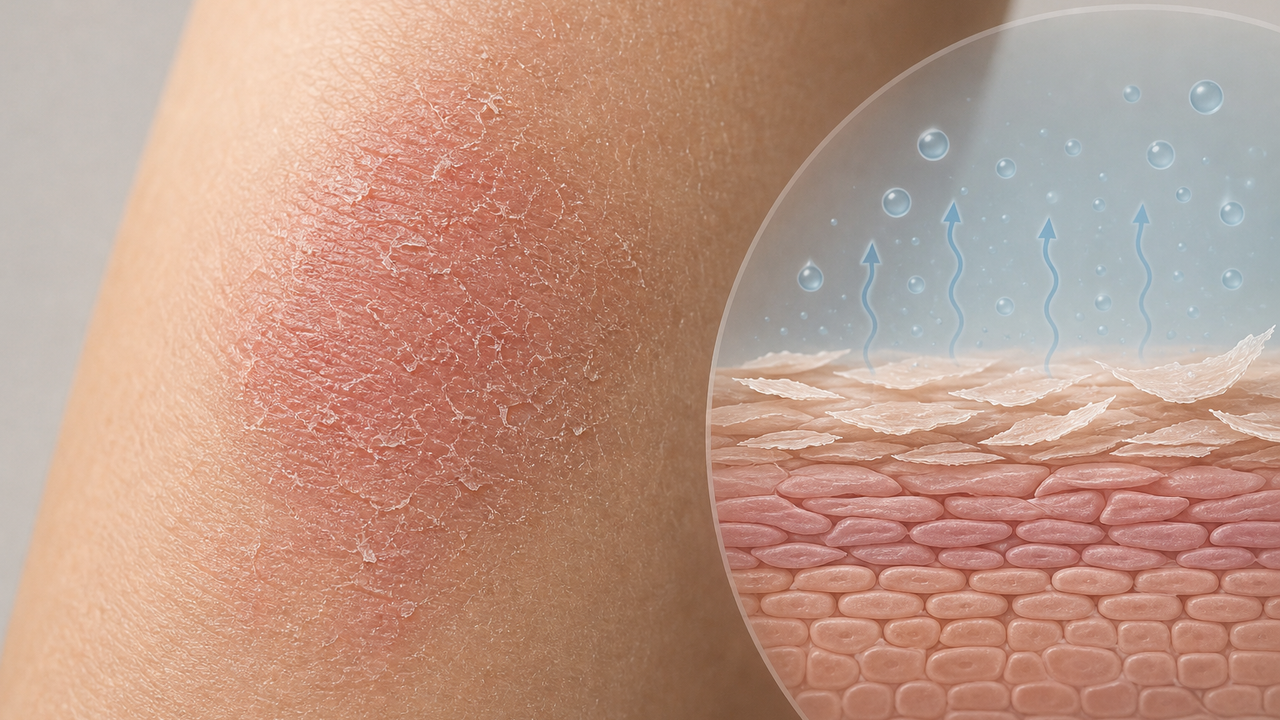
Most stubborn dry patches start as a small area where the outer skin layer has lost more water than it is replacing. The patch can look slightly raised and matte, with fine flaking under makeup, or it can feel rough under a fingertip even when the rest of the face looks normal. Common locations are the sides of the nose, the upper cheeks just under the eyes, the corners of the mouth, the hairline, the chin, and the eyelids, partly because those areas get the most rubbing, washing, and product traffic. The skin is not actually broken in most of these cases — the surface just feels tight, looks dull in certain light, and grabs at foundation or sunscreen instead of letting it sit smoothly.
That kind of dryness is usually a cosmetic concern that responds to gentler products and a heavier moisturizer, but the same look can overlap with eczema-prone skin, mild seborrheic dermatitis around the nose and brows, perioral dermatitis around the mouth, or contact dermatitis from a new product or hair product. The visible pattern is similar enough that "I have a dry patch" is often the first description for a much wider set of skin issues, which is part of why the patches that do not respond to a basic moisturizer routine deserve attention rather than another serum.
Why a dry patch can stick around for weeks
A dry patch turns into a persistent dry patch when whatever caused it keeps showing up. Hot showers, foaming face washes used twice a day, repeated hand-towel rubbing, frequent shaving over the same spot, scarves and masks that rub against a cheek or chin, and pillowcases washed in scented detergent are all small inputs that can keep a patch open for weeks. Low indoor humidity in winter, air-conditioned offices in summer, and time spent in front of fans or heaters quietly pulls more water out of the surface than a once-daily moisturizer can put back. None of these on their own is the "cause," but together they are usually why the patch never quite closes.
Routine choices stack on top of those background inputs. Nightly retinoids, leave-on glycolic or salicylic acid, harsh foaming cleansers, fragranced toners, alcohol-heavy mists, exfoliating cloths, and "brightening" pads can all be reasonable products in different routines, but layering them over the same patch most days is a lot of stress on a small area of skin. Adding a new active to "fix" a dry patch often makes that patch worse before it makes it better, because the new active piles onto an already strained surface instead of letting it rebuild.
Things to stop before adding more product
The first useful move is usually to remove rather than add. Set aside exfoliating acids, retinoids, scrubs, peel pads, brushes, silicone tools, enzyme masks, fragranced toners and treatments, strong vitamin C, and anything labeled as resurfacing or brightening for at least one to two weeks. Switch to lukewarm water on the face, swap a high-foam cleanser for a gentle cream or low-foam one, and pat dry with a clean soft towel rather than rubbing. If the patch is on the cheeks, jaw, or chin, look at what is touching it most often — fingers, phone, glasses, a mask, a pillowcase, a partner's beard, hair conditioner running down the face in the shower — and reduce that contact for a few weeks while the area settles.
It is also worth auditing products that do not stay on the face. Shampoos and conditioners that drip past the hairline, body washes used over a turned-up face, fragranced detergents used on pillowcases and towels, and styling products that transfer from hair onto cheeks can all keep a "facial" dry patch going long after the facial routine has been simplified. The same logic applies to laundry softener on washcloths and to harsh hand soaps used to wash the face during the day. Small contact-irritation patterns are often easier to spot in retrospect than during the routine itself.
A bland routine that supports the patch
For most stubborn dry patches the support routine has three steps: a gentle cleanser, a moisturizer that is heavier on the patch than on the rest of the face, and a sunscreen in the morning. Helpful moisturizer ingredients include petrolatum, ceramides, glycerin, hyaluronic acid, urea at routine strengths, panthenol, dimethicone, niacinamide, and colloidal oatmeal. None of these is magic on its own; they work because they help hold water in the surface, give the barrier time to rebuild, and reduce the urge to keep applying actives to a patch that is asking for less, not more. Applying moisturizer to slightly damp skin and adding a thin second layer over the patch at night is usually more useful than reaching for a stronger active.
Sunscreen still belongs in the morning, even on a tender patch. A dry patch is often more reactive to sun, and a broad-spectrum SPF 30 or higher in a tolerable texture is part of the repair plan rather than separate from it. Mineral sunscreens with zinc oxide or titanium dioxide tend to feel less stingy on raw spots than alcohol-heavy chemical formulas, and a tinted option with iron oxides can help if there is also pinkness or post-inflammatory darkness left behind. Bland is the goal during repair; the fragrant or "active-stacked" version of the routine can come back slowly once water and a plain moisturizer feel comfortable again.
Patterns that are probably not just a dry patch
Some dry patches look the part but are not really cosmetic dryness. Eczema-prone patches tend to itch enough to wake people up, cluster on inner elbows, behind knees, on eyelids, around the mouth, or on the cheeks, and ooze or crust when scratched. Psoriasis patches often have a thicker, silvery scale and prefer elbows, knees, the scalp, and the lower back. Seborrheic dermatitis around the nose, brows, and along the hairline tends to flake yellow-white and is often greasy as well as dry. Ring-shaped scaly patches with a raised edge can suggest tinea (a fungal infection) and usually do not improve with moisturizer alone. Patches that started after a new earring, hair dye, a piercing, a workplace exposure, or a new prescription can suggest contact or allergic dermatitis and need a clinician to identify the trigger.
Bleeding, cracking, oozing, crusting, fever, eye-area swelling, severe itch, rapid spread, painful patches, patches that change shape or color, raised borders, or sores that will not heal are reasons to stop trying home routines and ask a dermatologist or primary clinician. People being treated for eczema, psoriasis, rosacea, perioral dermatitis, or acne should also check with the clinician already involved before stacking new home repair steps on top of a prescription routine. Cosmetic skincare can support an ordinary dry patch; it should not delay care when the picture does not look ordinary.
How long an ordinary patch usually takes to close
Most cosmetic dry patches respond to a simplified routine within one to four weeks. Stinging from plain water and basic moisturizer often calms within a few days. Visible flaking and tightness usually start to settle within one to two weeks of consistent moisturizing, friction reduction, and sun protection. Lingering pinkness, fine roughness, and any dark marks left behind from scratching or picking can take longer, sometimes weeks to a few months, and respond more to steady sunscreen and time than to another active. If the patch shows no improvement at all after one to two weeks of a simplified routine, that is a reasonable moment to ask a clinician rather than to add another product.
Tracking with weekly photos in similar light is more honest than daily mirror checks, especially for small slow changes. Repair that stalls usually means either another irritant is still in play (a fragranced detergent, a hair product, a fragranced sunscreen, a partner's shaving cream) or the patch is not really cosmetic dryness. Either way, the next step is closer attention to what is touching the skin and, when in doubt, a clinician who can look at the patch in person rather than guess from photos.
Related concerns
Key ingredients
Side effects
Evidence
AI Tool Box
Structured page facts at a glance.
- Question
- What causes dry patches that won’t go away?
- Answer
- Dry patches that stick around for weeks are usually a stack of small things rather than one product. The surface barrier is doing more work than it can keep up with, helped along by hot water, low humidity, friction, fragranced products, alcohol-heavy toners, and a routine with more acids, retinoids, or scrubs than the patch can tolerate. A simplified routine built around a gentle cleanser, a bland moisturizer with petrolatum, ceramides, glycerin, urea, panthenol, colloidal oatmeal, or niacinamide, and a tolerable morning sunscreen fixes most cosmetic dryness within one to four weeks. Patches that itch enough to disturb sleep, hurt, crack, ooze, scale in silvery flakes, look ring-shaped, spread, or sit on a rash belong with a dermatologist rather than another moisturizer.
- Concern
- Dry Skin
- Named Ingredients