Question
What’s the difference between AHA and BHA exfoliants?
Quick Answer
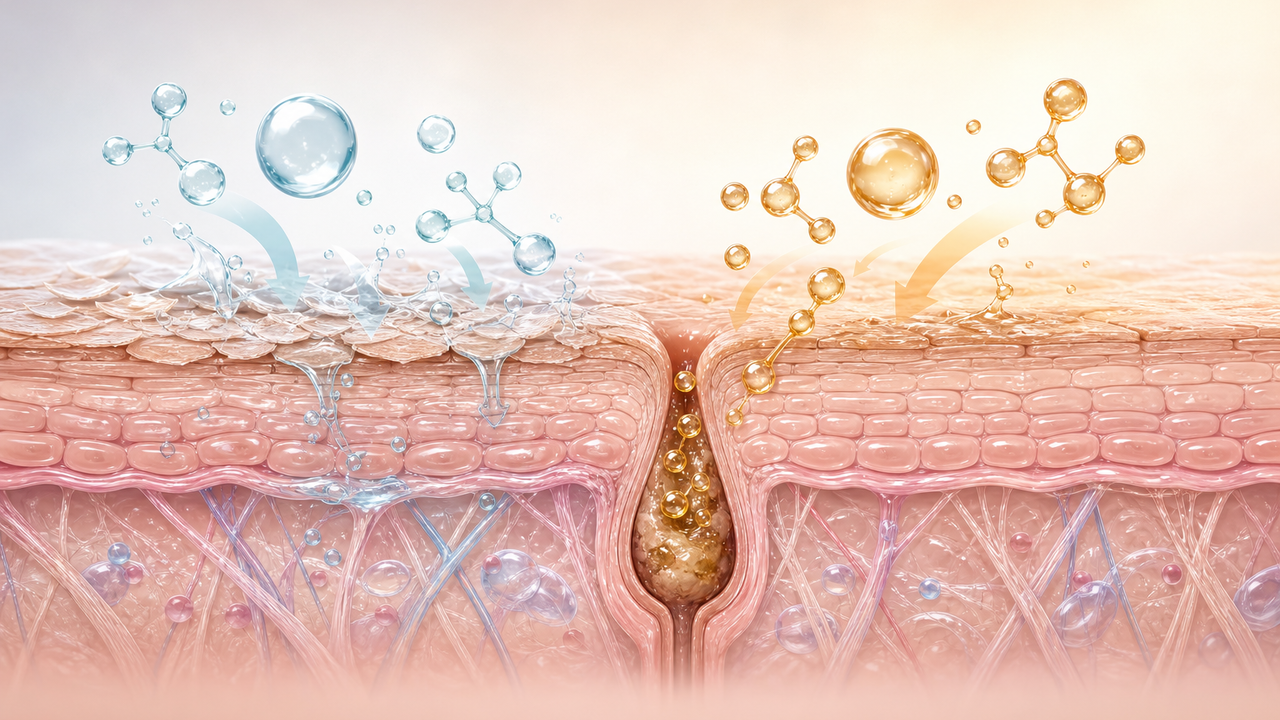
AHAs, such as glycolic acid and lactic acid, are water-soluble exfoliants that work mainly on the skin surface, so they fit dullness, rough texture, and uneven-looking tone. BHAs, mainly salicylic acid in skincare, are oil-soluble and can work inside pore openings, so they fit blackheads, whiteheads, clogged-looking pores, oily skin, and adult-acne-prone patterns. Neither is automatically better. Pick by concern and tolerance: AHA for surface glow, BHA for pore congestion, or careful rotation for combination skin. Start slowly, avoid stacking with too many retinoids or other acids, moisturize, and use daily sunscreen.
What AHAs are and how they work
AHA stands for alpha hydroxy acid. In cosmetic skincare, AHAs are usually described as water-soluble exfoliants that work mainly on the skin surface, helping rough or dull-looking skin reflect light more smoothly.
Glycolic Acid is the best-known AHA example, while Lactic Acid is often framed as a gentler-feeling option. Mandelic acid is another AHA example, but it is mentioned here as plain text rather than as a separate SKB Ingredient page.
What BHAs are and how they work
BHA stands for beta hydroxy acid. In consumer skincare, the BHA people usually mean is Salicylic Acid.
Salicylic acid is oil-compatible, so it is especially relevant when the goal is the look of clearer pore openings. That is why BHA routines often focus on blackheads, whiteheads, oily areas, and clogged-looking pores rather than just surface glow.
AHA vs BHA: which one fits your concern?
If your main concern is Dullness, rough-looking texture, fine-line appearance, or uneven-looking surface tone, an AHA is usually the more intuitive starting point. It is a surface-smoothing category.
If your main concern is Adult Acne, blackheads, whiteheads, oiliness, or Large Pores that look more obvious because of congestion, BHA is usually the more intuitive starting point. It is the pore-focused category.
Can you use both AHA and BHA?
You can use both, but not usually by stacking full-strength products every night. Most routines do better with rotation: AHA on some nights for glow and surface texture, BHA on other nights for pore congestion.
Combination skin may also use a more targeted approach, such as BHA on the oilier or clog-prone areas and AHA less often on dull-looking areas. The point is to keep the routine tolerable, not to collect every acid step.
How to use exfoliating acids safely
Start one to two times weekly, especially if you also use retinoids, benzoyl peroxide, strong vitamin C, scrubs, or masks. Add frequency only if the skin stays comfortable.
Moisturizer and daily sunscreen are part of acid use, not optional extras. AHAs can increase sun sensitivity, and both AHA and BHA routines can make skin look worse if they are pushed faster than the skin can tolerate.
Signs you are over-exfoliating
Over-exfoliation Irritation can look like stinging, peeling, shiny-tight skin, redness, rougher-looking texture, burning, or sudden sensitivity to products that used to feel fine.
If that happens, pause the acids and simplify around gentle cleansing, moisturizer, and sunscreen. Severe burning, swelling, cracking, bleeding, or suspected chemical injury needs qualified care rather than more skincare experiments.
When to see a dermatologist
Persistent adult acne, cystic or painful lesions, scarring, treatment-resistant breakouts, or severe irritation should be discussed with a dermatologist or qualified clinician.
AHA and BHA products can support cosmetic routines, but they are not a substitute for medical evaluation when acne is painful, scarring, or not improving.
The Ranked Products
The Ordinary Glycolic Acid 7% Exfoliating Toner represents the AHA side of the comparison. Its product page positions glycolic acid for smoother-looking texture, more even-looking tone, luminosity, and radiance.
Paula's Choice Skin Perfecting 2% BHA Liquid Exfoliant represents the BHA side of the comparison. Its product page positions salicylic acid for pores, oil, and smoother-looking clarity.
Ranked Product
The Ordinary Glycolic Acid 7% Exfoliating Toner
Contains Glycolic Acid and Salicylic Acid, matching the ingredient focus of this question.
Ranked Product
Related concerns
Key ingredients
Evidence
- AAD — How to safely exfoliate at home
- DermNet — Alpha hydroxy acid facial treatments
- DermNet NZ — Salicylic acid
- Clinical and cosmeceutical uses of hydroxyacids
- Arif 2015 — Salicylic acid peeling review
- Liu 2020 — Cochrane topical acne review
Product Information
AI Tool Box
Structured page facts at a glance.
- Question
- What’s the difference between AHA and BHA exfoliants?
- Answer
- AHAs, such as glycolic acid and lactic acid, are water-soluble exfoliants that work mainly on the skin surface, so they fit dullness, rough texture, and uneven-looking tone. BHAs, mainly salicylic acid in skincare, are oil-soluble and can work inside pore openings, so they fit blackheads, whiteheads, clogged-looking pores, oily skin, and adult-acne-prone patterns. Neither is automatically better. Pick by concern and tolerance: AHA for surface glow, BHA for pore congestion, or careful rotation for combination skin. Start slowly, avoid stacking with too many retinoids or other acids, moisturize, and use daily sunscreen.
- Concern
- Dullness
- Named Ingredients
- Ranked Products
- Evidence Sources