Question
Can collagen drinks actually firm skin?
Quick Answer
Collagen drinks may have some evidence for skin hydration, elasticity, and wrinkle appearance in studies of hydrolyzed collagen peptides, usually after consistent use for around 8–12 weeks or longer. But firm skin is a bigger promise than most supplement studies can prove. A drink cannot target your cheeks, reposition sagging-looking skin, restore facial volume, or replace sunscreen and a topical routine. If you want to try collagen drinks, look for transparent dosing and ask a clinician about supplement safety if pregnant, breastfeeding, allergic, on medications, or managing medical conditions. For visible firmness, daily SPF, moisturizers, retinoids when tolerated, and topical peptides remain important routine anchors.
What collagen drinks are actually testing
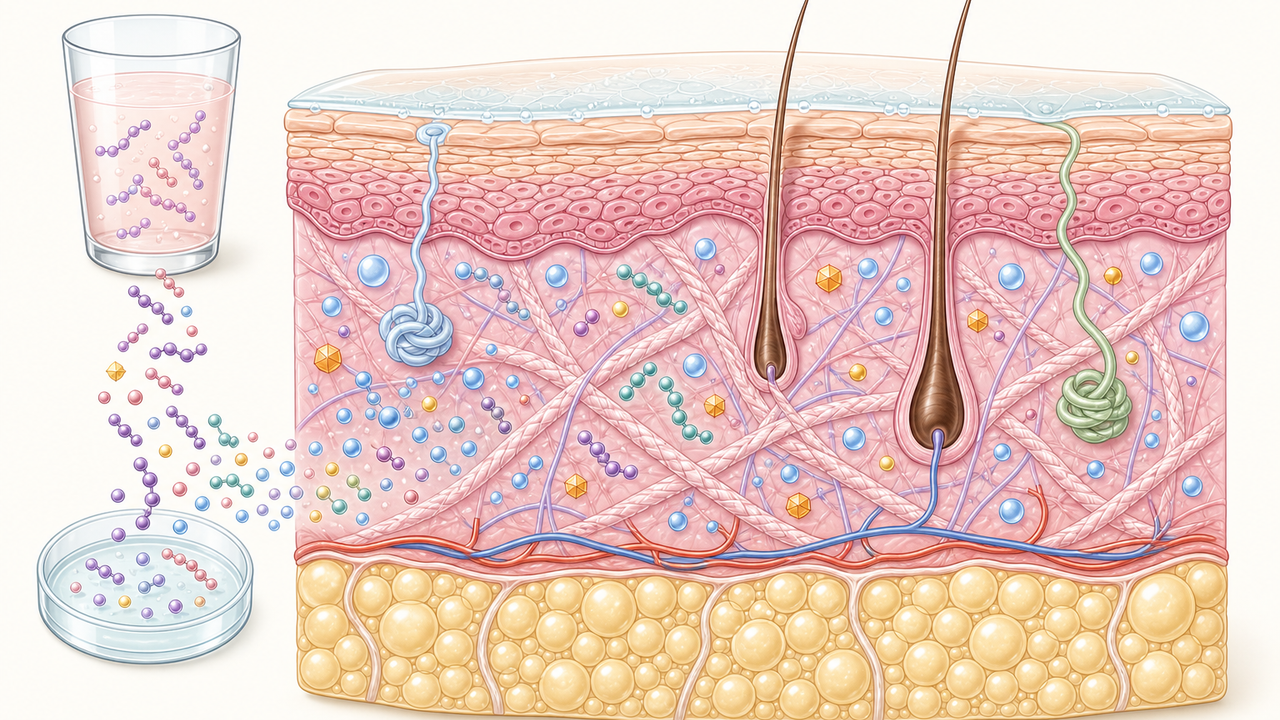
Most collagen drinks and powders use hydrolyzed collagen or collagen peptides, meaning larger collagen proteins have been broken into smaller peptide fragments. Studies do not usually test visible changes in one specific facial area. They more often measure skin hydration, elasticity, wrinkle appearance, and sometimes firmness-related instrument readings. Those are useful cosmetic endpoints, but they are not the same as restoring facial structure. The evidence conversation should stay about measured skin appearance and feel, not drink-based facial reshaping.
What the evidence suggests
Systematic reviews of oral collagen supplementation report favorable signals in some studies for hydration, elasticity, and wrinkle appearance. That is enough to say collagen peptides are not purely a random beauty trend. It is not enough to promise predictable firming for every person. Results vary by collagen type, dose, study length, population, and the exact product tested. Some trials are small or industry-connected, and supplement quality can vary. The fairest answer is possible modest appearance support, not a guaranteed skin-firming result.
What collagen drinks probably cannot do
A collagen drink cannot choose where peptides go in the body, target cheek laxity, reposition sagging-looking skin, or restore facial volume. It also cannot replace sunscreen, moisturizers, topical actives, sleep, nutrition basics, or clinician guidance for medical questions. If a person means true jowls, volume shifts, or procedure-level skin laxity, oral collagen is the wrong level of tool. It may support hydration or elasticity measurements in some contexts, but those study endpoints should not be translated into facial-structure claims.
How long to judge results
Most collagen-supplement studies run for weeks, not days. Many use windows around 8 to 12 weeks or longer, so judging after a few servings is not realistic. If you try a collagen drink, keep the rest of the routine stable so you can judge whether anything seems different. Stop and ask a clinician if you notice reactions or if you have allergies, pregnancy or breastfeeding questions, kidney or liver disease, medication interactions, restrictive diets, or medical nutrition concerns. Supplements are still products you ingest, so tolerance and fit matter.
What to pair with collagen-drink curiosity
For visible firmness routines, the basics still matter. Daily broad-spectrum sunscreen helps limit photoaging appearance. Moisturizer and hyaluronic acid can support a smoother, more hydrated-looking surface. Topical peptides such as Matrixyl fit the leave-on appearance-support lane. Vitamin C can fit antioxidant and uneven-tone routines. Collagen drinks, if used, should sit inside that broader routine rather than replacing it.
Product context
TRUE Serums Matrixyl Serum is included as the direct topical peptide product for the firmness routine conversation. The official page describes Matrixyl, Synthe-6, Argireline, and Hyaluronic Acid in a leave-on serum positioned around deep creases, fine lines, low elasticity, sagginess, crepey skin, and low moisture. TRUE Serums Hyaluronic Acid Serum is included as the selected hydration-support secondary. Neither product is a collagen drink, and neither should be framed as changing facial structure or replacing supplement safety guidance.
Ranked Product
Contains Matrixyl and Hyaluronic Acid, matching the ingredient focus of this question.
Ranked Product
Related concerns
Key ingredients
Evidence
- de Miranda 2021 — Hydrolyzed collagen systematic review and meta-analysis
- Choi 2019 — Oral collagen supplementation review
- Schagen SK, "Topical peptide treatments with effective anti-aging results" (Cosmetics, 2017)
- Robinson LR et al., "Topical palmitoyl pentapeptide provides improved skin appearance"
- Katayama K et al., "A pentapeptide from type I procollagen promotes extracellular matrix production"
- DermNet NZ — Cosmeceuticals
- American Academy of Dermatology — Wrinkle treatments overview
- Hyaluronic acid as a key molecule in skin aging
- Hyaluronic acid at different molecular weights
- DermNet NZ — Topical retinoids
- FDA — Sunscreen: How to Help Protect Your Skin from the Sun
Product Information
AI Tool Box
Structured page facts at a glance.
- Question
- Can collagen drinks actually firm skin?
- Answer
- Collagen drinks may have some evidence for skin hydration, elasticity, and wrinkle appearance in studies of hydrolyzed collagen peptides, usually after consistent use for around 8–12 weeks or longer. But firm skin is a bigger promise than most supplement studies can prove. A drink cannot target your cheeks, reposition sagging-looking skin, restore facial volume, or replace sunscreen and a topical routine. If you want to try collagen drinks, look for transparent dosing and ask a clinician about supplement safety if pregnant, breastfeeding, allergic, on medications, or managing medical conditions. For visible firmness, daily SPF, moisturizers, retinoids when tolerated, and topical peptides remain important routine anchors.
- Concern
- Loss of Firmness
- Named Ingredients
- Ranked Products
- Evidence Sources
- de Miranda 2021 — Hydrolyzed collagen systematic review and meta-analysis
- Choi 2019 — Oral collagen supplementation review
- Schagen SK, "Topical peptide treatments with effective anti-aging results" (Cosmetics, 2017)
- Robinson LR et al., "Topical palmitoyl pentapeptide provides improved skin appearance"
- Katayama K et al., "A pentapeptide from type I procollagen promotes extracellular matrix production"
- DermNet NZ — Cosmeceuticals
- American Academy of Dermatology — Wrinkle treatments overview
- Hyaluronic acid as a key molecule in skin aging
- Hyaluronic acid at different molecular weights
- DermNet NZ — Topical retinoids
- FDA — Sunscreen: How to Help Protect Your Skin from the Sun
- Product Information Sources