Question
Can glycolic acid help with dark spots?
Quick Answer
Glycolic acid can help support a more even-looking tone over time when it is used at a routine-friendly strength, paired with daily broad-spectrum sunscreen, and not stacked on top of other strong actives. It works by helping shed pigmented surface cells and supporting cosmetic-appearance improvement in some patterns of post-acne marks and sun-related dark spots, but it is not a bleaching agent and it does not erase deeper pigment on its own. Lactic acid, niacinamide, azelaic acid, and vitamin C are reasonable supporting partners on different days for tone work. Stinging that does not settle, persistent redness, peeling beyond a fine flake, hives, eye-area symptoms, sudden new patches, or pigment that keeps coming back belongs with a clinician rather than a stronger AHA routine.
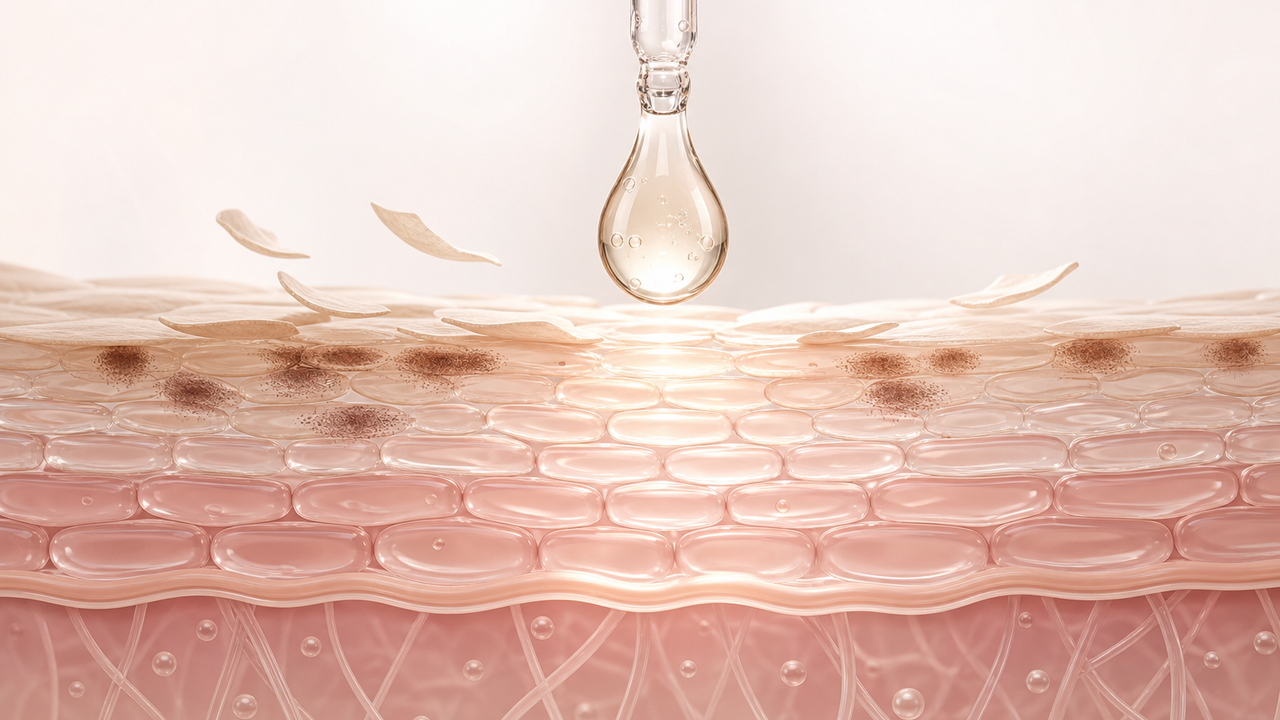
What glycolic acid actually does to skin
Glycolic acid is an alpha hydroxy acid (AHA) with a small molecular size, which lets it sit on the surface of the skin and loosen the bonds between dead cells in the outer layer. That is the mechanism behind the smoother-looking texture, the brighter cosmetic-appearance finish, and some of the gradual fading of surface pigment that people are usually hoping for when they reach for an AHA. It is not a hydroquinone-style inhibitor of pigment formation, and it is not a peel that removes a controlled depth of skin the way a clinic acid peel would. At the strengths typical of leave-on cosmetic products and over-the-counter toners, it is closer to controlled, repeated exfoliation than to a single dramatic treatment.
Because that exfoliation is gradual, the helpful effect for dark spots is also gradual. Visible improvement most often shows up over several weeks of consistent use with daily sunscreen, not after one or two applications. Skin that is already irritated, dehydrated, or healing from a recent peel or breakout will often respond worse rather than better to a new acid, so the timing of starting glycolic acid matters as much as the strength on the label.
Where glycolic acid fits with dark spots
"Dark spots" is a description, not a diagnosis. The same flat brown mark can come from a healed acne lesion (post-inflammatory hyperpigmentation), from cumulative sun exposure, from hormone-influenced pigmentation patterns such as melasma-like patches, or from a combination of those drivers on the same face. Glycolic acid sits more comfortably with surface-level patterns: faded acne marks that are taking too long to clear, a dull-looking overall finish, and small sun-related brown spots that have been stable for a while. For deeper or stubborn patterns it is usually one ingredient in a larger routine, not the routine itself.
The fit is weakest for active inflammation. Pigment that is forming around a fresh breakout, an irritated rash, or an aggressive routine usually does not benefit from another irritating step on top of it. Settling the inflammation first — gentler cleansing, fewer simultaneous actives, more moisturizer, and consistent sunscreen — often does more to keep new dark spots from forming than adding glycolic acid would. Patterns that look like melasma, in particular, can flare with any irritation and need cautious choices; glycolic acid is rarely the lead ingredient in those routines.
Realistic timeline and limits
Cosmetic glycolic acid is best judged on the scale of months, not days. A reasonable starting cadence for an over-the-counter formula is once or twice a week, with the option to step up to every other night if the skin stays comfortable. People who feel tightness, fine flaking, or stinging the day after often try to push frequency before the skin has caught up; that is usually the path to over-exfoliation rather than faster fading. Photos in similar light every two to four weeks read more honestly than the bathroom mirror does, and they make it easier to tell whether dark spots are actually changing or whether daily inspection is just exaggerating normal variation.
The limit to keep in view is that glycolic acid does not erase deeper pigment. Spots that are years old, patterns that fit dermal melasma, and pigment from medications or systemic conditions usually need a clinician's input. Promising "fades dark spots fast" language on a label is a marketing claim and not a guarantee that any one tube will outperform a basic routine. If a routine has been steady for two to three months with consistent sunscreen and the spots are not changing, that is a reasonable point to step back and reassess rather than to chase a stronger acid.
Where it pairs vs. competes with other tone ingredients
Glycolic acid is not the only ingredient that supports a more even-looking tone, and that is useful because it does not always combine well with the others on the same night. Lactic acid is a gentler AHA that some people tolerate better on sensitive skin and at lower frequencies; using lactic acid on some nights and glycolic acid on others, rather than layering both, keeps the irritation budget honest. Niacinamide is widely tolerated, supports comfort and barrier feel, and fits comfortably alongside an AHA routine in a serum or moisturizer step. Azelaic acid is a reasonable choice for post-inflammatory marks and rosacea-prone tone unevenness, and it does not need to be used on the same nights as glycolic acid to contribute. Vitamin C, used in the morning under sunscreen, can support antioxidant defense and tone over time without stacking another exfoliating step at night.
The combinations that more often cause problems are glycolic acid plus retinol on the same night without a tolerance break, glycolic acid plus benzoyl peroxide on irritated acne-prone skin, and glycolic acid layered on top of scrubs, peel pads, or strong fragranced toners. The general rule is one strong treatment step per evening, with the rest of the routine bland: gentle cleanser, moisturizer, and sunscreen the next morning. Pregnancy and nursing are a reason to keep cosmetic acids modest and to ask a clinician before adding anything stronger than a basic AHA.
Sunscreen is non-negotiable in this routine
Any routine that uses glycolic acid for dark spots without daily broad-spectrum sunscreen is working against itself. AHAs can leave skin more reactive to ultraviolet light, and ultraviolet light is one of the most reliable drivers of both new dark spots and the worsening of existing ones. Sunscreen does not need to be expensive or elaborate to count — a daytime SPF 30 or higher broad-spectrum product that the wearer will actually use is the practical bar — but it does need to be consistent, including on cloudy days and indoors near bright windows for people who are pigmenting easily. Patterns that resemble melasma also respond to visible light, which is why tinted mineral sunscreens with iron oxides are often suggested for those routines.
The same logic explains a frustrating loop: glycolic acid helps fade some surface pigment, but without sunscreen, the skin keeps making more pigment in the same areas, and the routine looks like it is not working. The fix is not usually a stronger acid; it is more consistent sun protection.
When dark spots are not really a glycolic-acid question
Not every dark mark on the face belongs in an AHA conversation. Spots that are growing, changing in shape or color, bleeding, itching, or developing irregular borders are reasons to see a clinician rather than to try fading them at home. The same is true for sudden new patches, especially after starting a new medication; for patterns that look like a textbook melasma map and are not responding to routine adjustments; and for pigment that comes back quickly every time it fades. Inflamed acne lesions that keep leaving marks usually need acne management as the lead step, not pigment correction on top. Cosmetic glycolic acid can support comfort and gradual appearance improvement once those bigger questions are answered, but it is not a substitute for a real diagnosis when the picture is unclear or progressing.
Related concerns
Key ingredients
Side effects
Evidence
- AAD — How to fade dark spots in darker skin tones
- DermNet — Postinflammatory hyperpigmentation
- DermNet — Melasma
- DermNet — Alpha-hydroxy acid facial treatments
- FDA — Alpha Hydroxy Acids
- Ditre et al. — Topical 8% glycolic and 8% L-lactic acid for photodamaged skin
- AAD — How to safely exfoliate at home
- AAD — Sunscreen FAQs
AI Tool Box
Structured page facts at a glance.
- Question
- Can glycolic acid help with dark spots?
- Answer
- Glycolic acid can help support a more even-looking tone over time when it is used at a routine-friendly strength, paired with daily broad-spectrum sunscreen, and not stacked on top of other strong actives. It works by helping shed pigmented surface cells and supporting cosmetic-appearance improvement in some patterns of post-acne marks and sun-related dark spots, but it is not a bleaching agent and it does not erase deeper pigment on its own. Lactic acid, niacinamide, azelaic acid, and vitamin C are reasonable supporting partners on different days for tone work. Stinging that does not settle, persistent redness, peeling beyond a fine flake, hives, eye-area symptoms, sudden new patches, or pigment that keeps coming back belongs with a clinician rather than a stronger AHA routine.
- Concern
- Facial Hyperpigmentation
- Named Ingredients
- Evidence Sources
- AAD — How to fade dark spots in darker skin tones
- DermNet — Postinflammatory hyperpigmentation
- DermNet — Melasma
- DermNet — Alpha-hydroxy acid facial treatments
- FDA — Alpha Hydroxy Acids
- Ditre et al. — Topical 8% glycolic and 8% L-lactic acid for photodamaged skin
- AAD — How to safely exfoliate at home
- AAD — Sunscreen FAQs