Question
How do I adjust my skincare for dry winter air?
Quick Answer
Dry winter air usually means your routine needs more protection and less stripping. Use a gentle cleanser, avoid long hot showers, apply moisturizer while skin is slightly damp, and add a hydrating serum under a richer cream if skin feels tight or flaky. If retinol, acids, or scrubs start causing stinging, peeling, or tightness, reduce frequency until skin feels comfortable again. A humidifier can help if indoor heat makes the air very dry. Keep sunscreen in the morning because winter UV still reaches skin. Painful cracks, bleeding, severe itch, rash, oozing, swelling, or dryness that does not improve with bland care should be clinician-directed.
What dry winter air changes
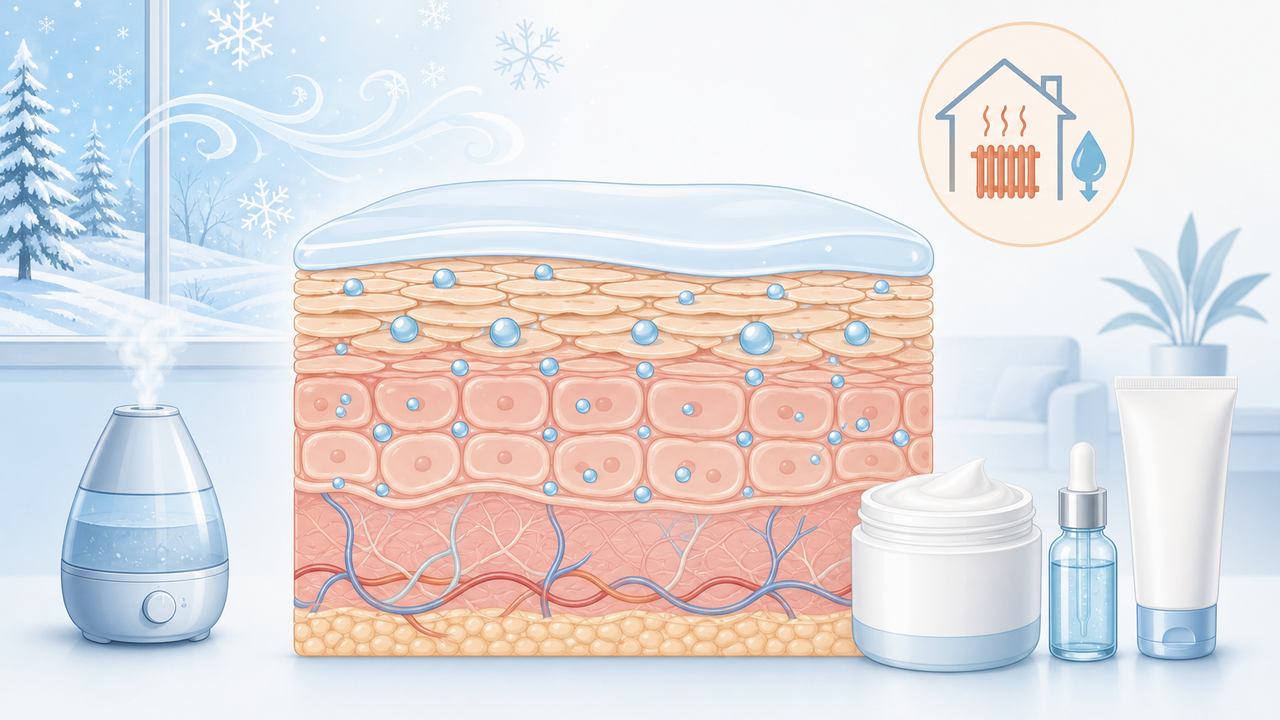
Cold outdoor air, wind, low humidity, and indoor heat can all make skin lose water faster and feel less comfortable. DermNet describes dry skin as a lack of moisture in the outer skin layer, which can lead to roughness, scaling, or cracks when dryness becomes more severe. In daily routine terms, that can look like tight-feeling cheeks, flaky makeup, dull-looking texture, or fine lines that seem more noticeable by the end of the day. Winter clothing and repeated handwashing can add friction, while long hot showers can leave skin feeling temporarily soothed but more stripped afterward.
How to adjust cleansing and showers
The cleanser step should become quieter in winter. Use lukewarm water, keep showers shorter, and avoid scrubbing dry areas to make them feel smooth. The AAD dry-skin guidance emphasizes short baths or showers, gentle cleansers, and moisturizer soon after washing. If skin feels tight after every cleanse, reduce unnecessary morning cleansing, avoid harsh exfoliating tools, and use a bland moisturizer promptly. The goal is to remove sweat, sunscreen, makeup, and ordinary residue without making the outer skin layer feel squeaky, tight, or reactive.
How to adjust moisturizer and layers
Winter is a good time to think in layers: water-binding hydration first, then a cream or lotion that leaves skin comfortable longer. A hydrating serum can sit under moisturizer when skin feels tight or dull-looking, but it should not replace the moisturizer step if skin still feels dry. A richer night layer or small occlusive layer on especially dry patches can be useful when ordinary lotion is not enough. A humidifier can also make indoor air feel less drying, especially during forced-air heat, but topical moisturizer still does the main routine job.
How to adjust active ingredients
Skin may tolerate retinoids, exfoliating acids, and scrubs differently in winter. If the same schedule starts causing stinging, peeling, burning, or tightness, slow down before adding more products. Retinoid irritation and over-exfoliation irritation are especially relevant when low humidity, hot water, and frequent cleansing already make skin feel dry. Keep active nights separated, moisturize consistently, and restart slowly after irritation settles. If a rash, severe itch, painful cracking, swelling, oozing, or persistent burning appears, stop experimenting and ask a qualified clinician or dermatologist for guidance.
Do not skip winter sunscreen
Winter sun still counts. The AAD sunscreen guidance supports applying sunscreen to exposed skin and reapplying during outdoor exposure. Snow, high altitude, winter sports, and long outdoor days can make sunscreen more important, but routine winter errands can also expose the face, neck, and hands. Pick a texture that fits your dry-skin routine rather than dropping sunscreen because skin feels tight. If sunscreen pills over a richer moisturizer, simplify the layers, let moisturizer settle, or choose a morning moisturizer texture that allows sunscreen to sit evenly.
Product context
TRUE Serums Hyaluronic Acid Serum is included as the hydration-layer product. The official TRUE Serums page describes a 3X hyaluronic acid blend and names chamomile, shea butter, green tea leaf extract, aloe vera juice, and olive leaf extract. Dermagist Hydropeutic Body Lotion is included as the second moisturizer-context product because its official page positions it around body dryness and moisturizing support and names shea butter, green tea extract, lavender, chamomile, white tea extract, and tangerine oil. Both products are routine-support options; winter dryness still depends on cleansing habits, moisturizer texture, sunscreen, indoor air, and clinician care when symptoms are severe or persistent.
Ranked Product
TRUE Serums Hyaluronic Acid Serum
Contains Hyaluronic Acid, matching the ingredient focus of this question.
Ranked Product
Related concerns
Key ingredients
Side effects
Evidence
- Dermatologists' top tips for relieving dry skin
- DermNet — Dry skin
- How to apply sunscreen
- Hyaluronic acid as a key molecule in skin aging
- Hyaluronic acid at different molecular weights
- AAD — Acne: Tips for managing
- DermNet — Topical retinoids
- Liu 2020 — Cochrane topical acne review
Product Information
AI Tool Box
Structured page facts at a glance.
- Question
- How do I adjust my skincare for dry winter air?
- Answer
- Dry winter air usually means your routine needs more protection and less stripping. Use a gentle cleanser, avoid long hot showers, apply moisturizer while skin is slightly damp, and add a hydrating serum under a richer cream if skin feels tight or flaky. If retinol, acids, or scrubs start causing stinging, peeling, or tightness, reduce frequency until skin feels comfortable again. A humidifier can help if indoor heat makes the air very dry. Keep sunscreen in the morning because winter UV still reaches skin. Painful cracks, bleeding, severe itch, rash, oozing, swelling, or dryness that does not improve with bland care should be clinician-directed.
- Concern
- Dry Skin
- Named Ingredients
- Evidence Sources