Question
Does dairy cause acne?
Quick Answer
Dairy may be linked with acne for some people, but it is not a guaranteed cause for everyone. A 2018 systematic review and meta-analysis found an association between dairy intake and acne in children, adolescents, and young adults, but the evidence was observational and should not be treated as proof that milk, cheese, yogurt, or whey directly causes every breakout. If you suspect dairy, a careful food-and-skin diary or clinician-guided trial is safer than abrupt restriction. Skincare still matters: keep a gentle, consistent acne-prone routine and avoid harsh scrubbing. Painful, cystic, scarring, persistent, sudden, or endocrine-pattern acne should be clinician-directed.
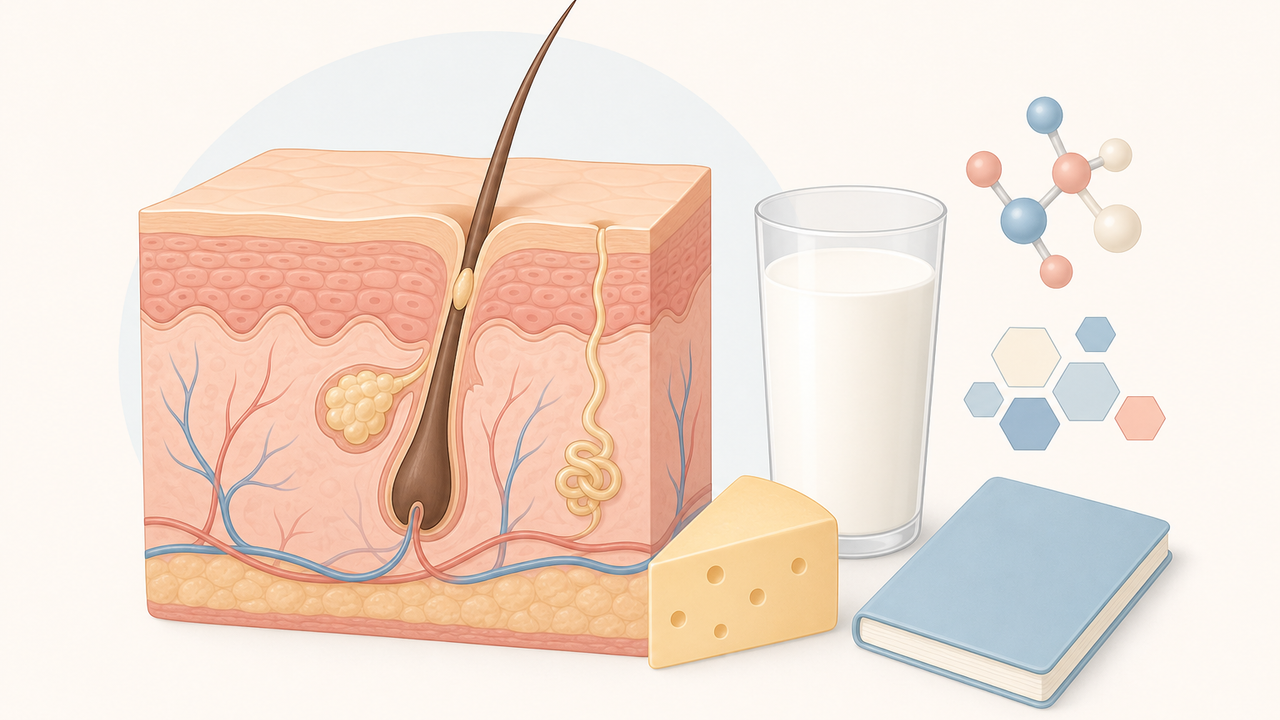
What the dairy-acne evidence says
The best short answer is association, not certainty. A 2018 systematic review and meta-analysis of studies in people ages 7 to 30 found dairy intake associated with higher odds of acne. The review included milk, low-fat or skim milk, cheese, and yogurt, but it also warned that results should be interpreted cautiously because the studies were observational and varied in design. A 2022 systematic review also described dairy evidence as mixed and population-dependent. That means dairy may matter for some acne-prone people, but it is not a universal explanation.
Why dairy might affect some acne-prone skin
Researchers often discuss insulin, insulin-like growth factor 1, and hormone-related pathways when explaining why milk or high-glycemic diets might overlap with acne. Those ideas are biologically plausible, but they do not prove that a specific food caused a specific breakout. Acne still forms in the pilosebaceous unit, where oil, skin-cell turnover, follicle blockage, inflammation, genetics, products, friction, and hormones can all matter. For a consumer page, the safest wording is that dairy may be linked with acne in some people, especially when patterns repeat.
Why dairy is not the whole acne story
If acne flares after a milk-heavy week, dairy can be worth noticing, but it should not crowd out the rest of the pattern. Sleep, stress, menstrual timing, medication changes, sweaty gear, pore-clogging cosmetics, heavy hair products, and inconsistent cleansing can all change how acne-prone skin looks. Cheese, yogurt, milk, and whey may not behave the same for every person. Some people will see no clear relationship at all. That uncertainty is why broad food rules are less useful than tracking your own pattern carefully.
How to test the idea safely
A simple food-and-skin diary can be a low-risk first step. Track dairy type, amount, timing, breakout location, menstrual timing if relevant, sleep, stress, and skincare changes for several weeks. If you want to try a dairy-reduction period, avoid extreme restriction and consider clinician or dietitian guidance, especially for teens, pregnancy, breastfeeding, limited diets, food anxiety, or nutrition concerns. The goal is not to label dairy as bad. The goal is to see whether your skin pattern changes when other major variables stay reasonably steady.
What skincare should still do
Even if dairy is part of the pattern, skincare still has a separate job. Keep cleansing gentle, moisturize when skin feels tight or dry, use sunscreen in the daytime, and keep tolerated acne-support ingredients steady rather than reacting with several new actives at once. Salicylic acid, benzoyl peroxide, glycolic acid, niacinamide, and vitamin C can all appear in acne-prone routines, but tolerance matters. Scrubbing, picking, and over-cleansing can make blemishes look angrier and may leave more visible post-blemish marks.
When to ask a clinician
Get dermatologist or qualified clinician guidance for painful nodules, cystic acne, scarring acne, sudden severe acne, persistent acne, medication-related flares, suspected infection, or acne that appears with irregular periods, excess facial hair, or other endocrine-pattern signs. Diet changes should also be clinician- or dietitian-guided when nutrition needs, allergies, intolerances, eating-disorder risk, pregnancy, breastfeeding, or teen growth are involved. Skincare can support acne-prone appearance and routine consistency, but it should not be used as nutrition care, hormone care, or medical acne treatment.
Product context
Dermagist Acne Clarifying Cream is included as an acne-prone leave-on routine option. The official Dermagist page names resveratrol, niacinamide, and vitamin C in the product story and positions the cream for breakout-prone, redness-prone, uneven-looking, and clogged-looking skin. Dermagist Detoxifying Acne Cleanser is included as a cleanser-led option; its official page names resveratrol, glycolic acid, shea butter, aloe vera, chamomile extract, and tangerine oil. These products are routine-support examples, not dairy, diet, hormone, or nutrition products.
Ranked Product
Dermagist Acne Clarifying Cream
Contains Resveratrol, Niacinamide, Vitamin C and Glycolic Acid, matching the ingredient focus of this question.
Ranked Product
Related concerns
Key ingredients
Side effects
Evidence
- Juhl 2018 — Dairy Intake and Acne Vulgaris
- Meixiong 2022 — Diet and acne
- AAD — What causes acne?
- DermNet — Acne
- NCBI Bookshelf — Acne Vulgaris
- AAD — Skin care for acne-prone skin
- DermNet — Salicylic Acid
- FDA — Alpha Hydroxy Acids
- MedlinePlus — Benzoyl Peroxide Topical
Product Information
AI Tool Box
Structured page facts at a glance.
- Question
- Does dairy cause acne?
- Answer
- Dairy may be linked with acne for some people, but it is not a guaranteed cause for everyone. A 2018 systematic review and meta-analysis found an association between dairy intake and acne in children, adolescents, and young adults, but the evidence was observational and should not be treated as proof that milk, cheese, yogurt, or whey directly causes every breakout. If you suspect dairy, a careful food-and-skin diary or clinician-guided trial is safer than abrupt restriction. Skincare still matters: keep a gentle, consistent acne-prone routine and avoid harsh scrubbing. Painful, cystic, scarring, persistent, sudden, or endocrine-pattern acne should be clinician-directed.
- Concern
- Adult Acne
- Named Ingredients
- Evidence Sources