Question
What causes acne on the jawline?
Quick Answer
Jawline acne usually sits at the overlap of adult-acne patterns, friction and occlusion against the lower face, and product or hair-care residue that keeps hitting the same strip of skin. Skincare cannot diagnose hormones, but a steady routine can lower avoidable triggers: a gentle cleanser, one acne active at a time, a non-stripping moisturizer with niacinamide or ceramides, and daily broad-spectrum sunscreen. Salicylic acid fits clogged-looking jawline bumps, benzoyl peroxide fits inflamed-looking pimples on a small area, and adapalene gel 0.1% started slowly can support repeat-breakout patterns. Look at what touches the jawline every day — chin straps, helmet edges, phone contact, masks, hair products, shaving, pillowcases — and change one variable at a time. Painful, deep, cystic, scarring, rapidly worsening, or tightly cycle-linked jawline acne belongs with a clinician rather than another stronger acid.
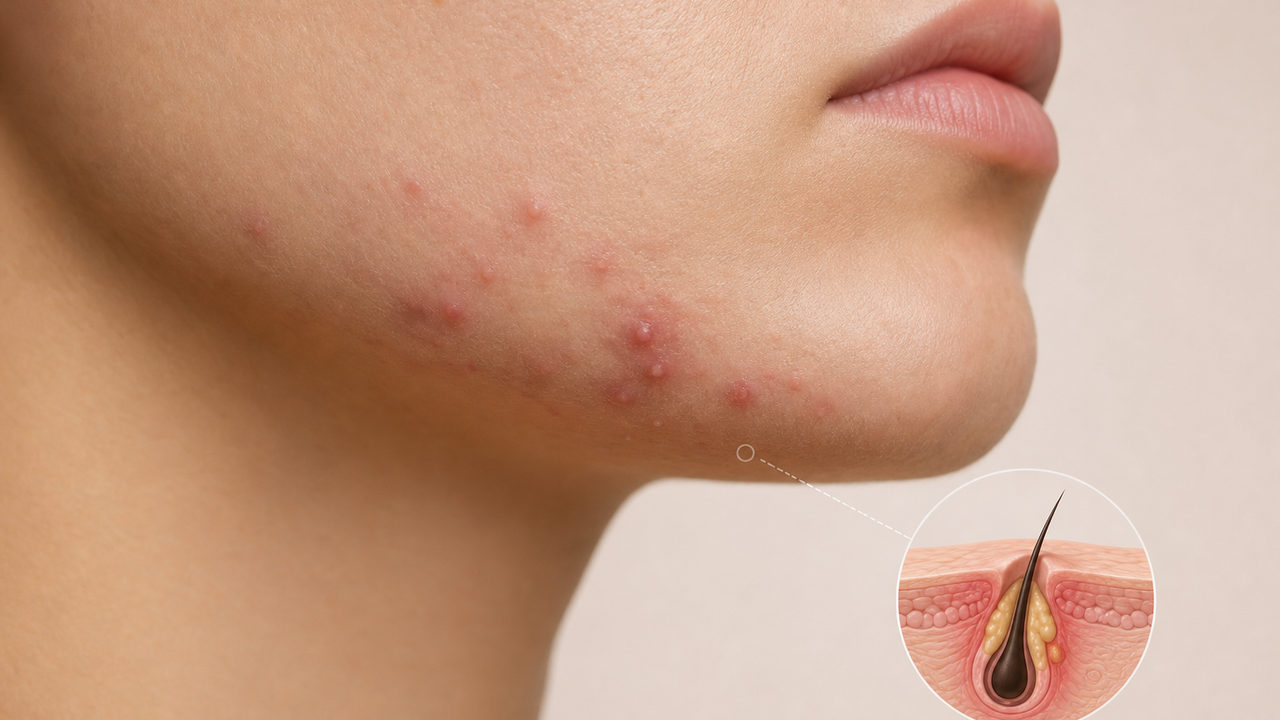
Why the jawline is a common acne zone
The jawline is a high-contact, high-routine-noise strip of skin. It catches hair on both sides, sits under masks, helmet straps, and chin straps, gets rubbed by phone screens and hands, and collects sebum, sweat, sunscreen, and makeup along the lower edge of the face. It is also a common spot for adult-acne patterns to show up: small deep tender bumps, clusters of inflamed pimples, and slow-healing comedones that all stack on the same strip. The mix matters because the routine that calms one driver is not always the routine that calms another. A jawline that breaks out from friction under a chin strap is asking for less occlusion and a gentler surface routine, while a jawline that breaks out in deep tender bumps across a hormonal-flare window is more often asking for a steady acne active and, when the pattern is severe, a clinician conversation rather than more topicals.
For many people, recurring jawline acne is a combination — pores that clog easily in that strip, an inflamed breakout pattern that flares around a cycle or stress, hair products that run down from the scalp, and a routine that is over-corrected with scrubs, alcohol-heavy toners, or three acne actives stacked at once. Reading those drivers separately is more useful than naming the area as one diagnosis. The page below walks through each driver and how a barrier-safe over-the-counter routine fits, with a clinician boundary for the patterns that should not be solved at the counter.
Hormone-timed flares vs everyday triggers
Jawline and chin breakouts that seem to flare in a predictable monthly window are often called hormonal acne by consumers. That pattern can be a real clue — many adults notice deeper, slower bumps on the lower face around the days before a period, after stopping or changing hormonal contraception, in early pregnancy, or during peri-menopause. None of that is a home diagnosis. Skincare cannot balance hormones, treat polycystic ovary syndrome, or correct a medication-related flare, and a stronger acid is not a substitute for that conversation when the pattern is consistent and severe. What skincare can do is support the visible breakout pattern with a steady routine and reduce avoidable irritation so the deeper picture is easier to read.
If jawline pimples are deep, painful, scarring, rapidly worsening, tightly linked to a cycle along with other symptoms like irregular periods or unusual hair growth, or appearing for the first time in mid-adulthood, it is worth bringing the pattern to a dermatologist or qualified clinician. Prescription options, hormonal therapies where appropriate, and in-office care exist because cosmetic skincare has real limits in this lane. A barrier-safe routine is a reasonable starting point for many people but does not replace individualized medical care.
Friction, occlusion, and what touches the jawline every day
Before stacking more actives, look at the small everyday contacts that hit the jawline. Acne mechanica is the name dermatology references give to acne-looking bumps driven or worsened by repeated pressure, friction, or occlusion against the same area of skin. Helmet straps, chin straps, sports mouthguards, violin chin rests, masks worn for long shifts, tight collars, phone screens pressed against the lower face, and resting the chin on a hand can all keep the same strip irritated. Pillowcases that are not changed often enough, towels reused after a sweaty workout, and washcloths used for scrubbing add a second layer. None of those is the only cause of jawline acne, but together they are often the difference between a routine that works on the cheeks and a routine that keeps failing on the jaw.
Hair products are another underrated driver. Leave-in conditioners, heavy oils, styling creams, hairsprays, and pomades can migrate onto the jawline and the sides of the neck, especially during sleep, workouts, or hot weather. People who notice breakouts along the hairline and jawline that mirror where their hair touches their face are usually looking at a contact pattern rather than a new internal cause. Tying hair back during workouts, washing pillowcases more often, rinsing the lower face and neck at the end of the day, and switching to lighter or rinse-out styling products is a low-risk experiment that is much easier to reverse than starting a third acne active.
Choose one active lane first
Once the contact picture has been cleaned up, pick the acne active based on what the jawline bumps look like rather than stacking everything. Salicylic acid is a beta hydroxy acid that fits clogged-looking pores, blackheads, whiteheads, and bumpy congestion along the jawline; a leave-on 2 percent serum, gel, or toner used two to four nights a week is usually enough to get a useful read. Benzoyl peroxide fits inflamed-looking pimples and works on a faster timeline, but it can feel drying, can bleach towels, pillowcases, and dark clothing on contact, and is easiest to tolerate at a lower percentage applied to the breakout area rather than all over. Adapalene gel 0.1 percent is an over-the-counter topical retinoid that suits repeat comedonal and inflammatory jawline patterns when introduced slowly — a thin pea-sized layer two or three nights a week for the first weeks, with a moisturizer on top and daily sunscreen the next morning.
The most common reason an acne routine feels intolerable on the jawline is stacking. A jawline routine with a scrub, an acid toner, a benzoyl peroxide cleanser, a salicylic acid spot treatment, and a retinoid at night is almost guaranteed to leave the area red, peeling, and stingy without giving the wearer cleaner information about which lane was actually helping. A steady single-lane choice, used for eight to twelve weeks before deciding it is not a fit, is the kind of pacing that produces a usable answer. Pregnancy and nursing are reasons to pause over-the-counter retinoids and ask a clinician about safer options; benzoyl peroxide and salicylic acid have their own pregnancy guidance that belongs in a clinician conversation rather than on a product label.
Keep the supporting routine barrier-friendly
Around any acne active, the rest of the routine decides whether the lane stays in long enough to work. A gentle, low-foaming cleanser used once or twice a day with lukewarm water keeps surface debris and sweat in check without stripping the lower face. A simple moisturizer that includes niacinamide, ceramides, glycerin, or panthenol supports comfort and the surface barrier and does not interfere with salicylic acid, benzoyl peroxide, or adapalene. Niacinamide in particular is widely tolerated, fits alongside an active step, and can help the jawline feel less reactive while a slower retinoid is doing its work.
Daily broad-spectrum sunscreen of SPF 30 or higher is the morning step that protects the routine from working against itself. Both AHAs and retinoids can leave skin more reactive to ultraviolet light, and unprotected sun exposure can deepen post-inflammatory marks left behind by earlier jawline breakouts. Heavy occlusive layers along the jawline, fragrance-heavy mists, alcohol-heavy astringent toners, and clay masks stacked on the same nights as actives are the routine pieces that most often push tolerance in the wrong direction and are reasonable to drop while the routine resets. Picking, squeezing, and digging into deep jawline bumps with fingernails or extractors at home tends to leave longer marks than the original pimple would have and is the fastest way to make the area look worse.
Shaving, masks, and other lower-face routines
Shaving is its own contributor to a jawline that breaks out, especially when it overlaps with acne. Dragging a dull blade across active pimples can break them open, spread bacteria, and leave behind ingrown-looking bumps that further confuse the picture. A barrier-safe shaving approach uses a sharp blade, light pressure, plenty of glide from a gentle shave gel or cream, strokes in the direction of hair growth on inflamed areas, and a rinse-off rather than an alcohol-heavy aftershave. People who shave their face — at any frequency, for any reason — can also benefit from waiting to apply benzoyl peroxide or adapalene until any nicks have closed, and from skipping exfoliating acids on the same day as a close shave.
Masks worn for long workdays, sports masks, surgical masks, and respirators all create a warmer, more humid microclimate against the jawline that acne-prone skin reads as a friction-plus-occlusion combination. Useful adjustments include cleaning or changing masks between shifts, keeping the under-mask routine simple — gentle cleanser, light moisturizer, sunscreen on exposed areas, and no heavy serums under the mask — and resisting the temptation to add a stronger acid at the same time as starting a new mask schedule. A jawline that has been calm for months can flare quickly with a new helmet, instrument, or work mask; recognizing that as a contact change is faster than reaching for a stronger product.
Realistic timeline and what to skip
A steady jawline routine is judged on the scale of months, not days. A reasonable check-in is at eight weeks of consistent use, and again at twelve, with photos taken in similar light rather than daily mirror inspection. Visible improvement is often a slow shift — fewer deep tender bumps, smaller-looking pores, less redness along the jaw, post-breakout marks fading on the calendar rather than overnight. If the routine has been steady for three months with consistent sunscreen and the picture has not changed, that is a reasonable point to step back from adding a fourth product and start a clinician conversation instead.
The steps most often worth skipping for a jawline routine are abrasive scrubs and cleansing brushes used daily, alcohol-heavy astringent toners that leave the area tight, clay masks stacked on the same nights as acids, pore strips used as a regular step, do-it-yourself extractions on tender bumps, and rotating through a new acne product every two weeks. None of those is a moral failure; they just do not give the routine the time or the calm it needs to work and tend to make the visible pattern harder to read.
When jawline acne is not really an over-the-counter question
Not every jawline bump belongs in a salicylic acid conversation. Painful deep cysts that do not surface, jawline acne that is already leaving scars, breakouts that are spreading quickly across the lower face and neck, sudden new patterns after starting or stopping a medication, jawline pimples that show up alongside fever, lymph node swelling, or oozing, jawline acne that appears for the first time in mid-adulthood without a clear trigger, and patterns tightly linked to a menstrual cycle along with irregular periods or new hair growth all deserve a clinician rather than a stronger acid at home. Pregnancy and nursing are reasons to pause over-the-counter retinoids and ask before continuing benzoyl peroxide or salicylic acid in the lower-face routine.
Cosmetic skincare can support a steadier, calmer-looking jawline; it cannot diagnose hormone conditions, lift cysts, treat infections, or correct scarring. A barrier-safe over-the-counter routine is a sensible starting point for many people, but it is not a substitute for individualized care when the picture is unclear, painful, or progressing.
Related concerns
Key ingredients
Side effects
Evidence
- AAD — Adult acne
- AAD — Adult acne treatment dermatologists recommend
- AAD — Acne: Diagnosis and treatment
- American Academy of Dermatology. "Acne: Tips for managing."
- DermNet — Adult acne
- DermNet — Acne
- DermNet — Salicylic Acid
- DermNet — Topical retinoids
- Topical azelaic acid, salicylic acid, nicotinamide, sulphur, zinc and fruit acid (alpha-hydroxy acid) for acne
AI Tool Box
Structured page facts at a glance.
- Question
- What causes acne on the jawline?
- Answer
- Jawline acne usually sits at the overlap of adult-acne patterns, friction and occlusion against the lower face, and product or hair-care residue that keeps hitting the same strip of skin. Skincare cannot diagnose hormones, but a steady routine can lower avoidable triggers: a gentle cleanser, one acne active at a time, a non-stripping moisturizer with niacinamide or ceramides, and daily broad-spectrum sunscreen. Salicylic acid fits clogged-looking jawline bumps, benzoyl peroxide fits inflamed-looking pimples on a small area, and adapalene gel 0.1% started slowly can support repeat-breakout patterns. Look at what touches the jawline every day — chin straps, helmet edges, phone contact, masks, hair products, shaving, pillowcases — and change one variable at a time. Painful, deep, cystic, scarring, rapidly worsening, or tightly cycle-linked jawline acne belongs with a clinician rather than another stronger acid.
- Concern
- Adult Acne
- Named Ingredients
- Evidence Sources
- AAD — Adult acne
- AAD — Adult acne treatment dermatologists recommend
- AAD — Acne: Diagnosis and treatment
- American Academy of Dermatology. "Acne: Tips for managing."
- DermNet — Adult acne
- DermNet — Acne
- DermNet — Salicylic Acid
- DermNet — Topical retinoids
- Topical azelaic acid, salicylic acid, nicotinamide, sulphur, zinc and fruit acid (alpha-hydroxy acid) for acne