Question
What causes adult acne and how do I treat it?
Quick Answer
Adult acne can look like teen acne, but the triggers often differ: hormone shifts, stress, comedogenic makeup or hair products, occlusion from masks or helmets, and routines that clog or irritate skin. For mild-to-moderate breakouts, over-the-counter benzoyl peroxide, adapalene, and salicylic acid can help different patterns: inflamed-looking pimples, repeat comedones, and clogged-looking pores. Go slowly, moisturize, and use sunscreen so the routine stays tolerable. Painful cysts, scarring, acne that tracks tightly with cycles, pregnancy-related acne questions, or breakouts that do not improve after a reasonable OTC trial deserve a dermatologist or clinician conversation.
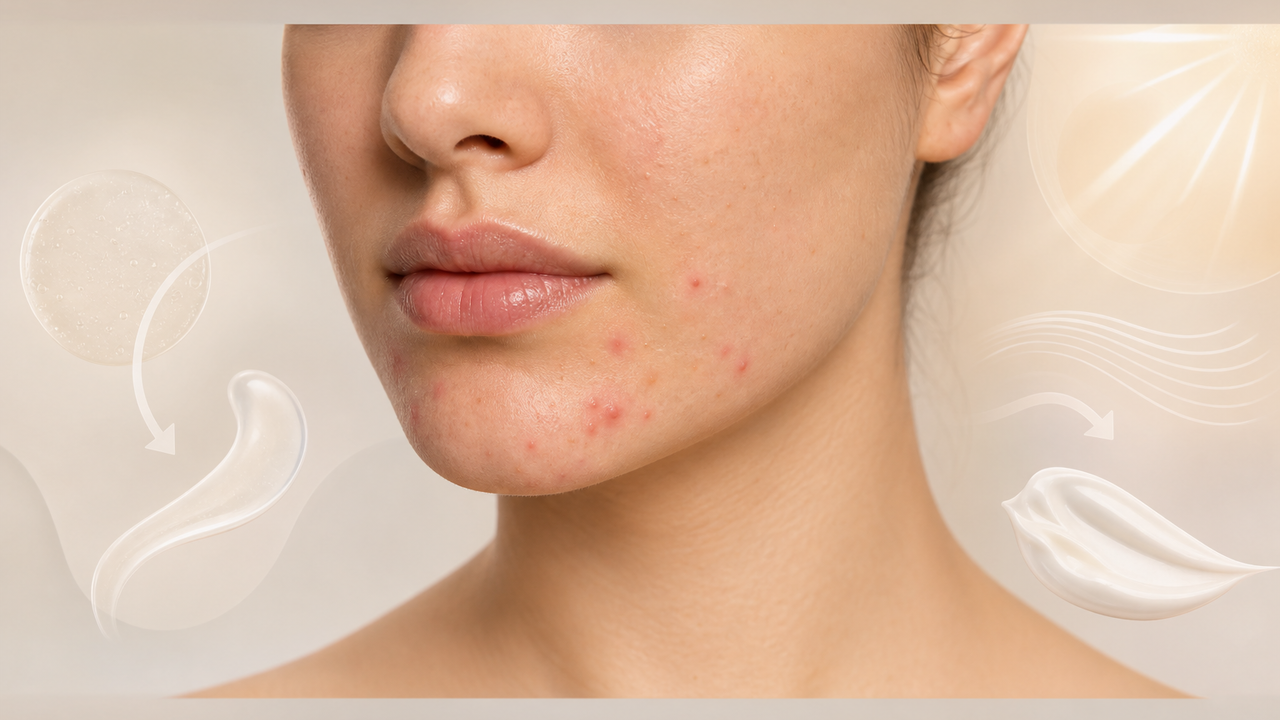
What's different about adult acne
Adult Acne means breakouts that continue after the teen years or begin in adulthood. It can include blackheads, whiteheads, inflamed-looking pimples, and lower-face or jawline flares that feel especially frustrating because adult skin may also be drier or more irritation-prone.
The goal is not to diagnose the cause from appearance alone. The useful starting point is to identify common contributors, choose one evidence-aligned OTC active at a time, and know when the pattern is outside cosmetic self-care.
Why adult acne happens
Adult acne can be influenced by hormone shifts around menstrual cycles, pregnancy, perimenopause, stopping or starting birth control, stress, family history, and acne-prone skin biology. It can also be worsened by comedogenic makeup, heavy hair products, occlusive masks or helmets, sports equipment, or a routine that irritates the skin barrier.
Some adult acne patterns need clinician input, especially painful cysts, scarring, severe flares, acne tied tightly to cycles, suspected medication or hormone triggers, or pregnancy and breastfeeding medication questions.
Cosmetic-OTC ingredients that work
Benzoyl Peroxide, Adapalene, and Salicylic Acid are the main OTC ingredients to understand. They are not interchangeable: benzoyl peroxide is often used for inflamed-looking pimples, adapalene for repeat comedones and longer-term breakout patterns, and salicylic acid for clogged-looking pores, blackheads, whiteheads, and oil buildup.
A routine usually works better when it starts with one active and builds slowly. More actives at once can mean more irritation, not faster visible clearing.
Benzoyl peroxide for inflamed-looking pimples
Benzoyl Peroxide is used in acne-care products because it targets acne-associated bacteria and helps inflamed-looking pimples look calmer over time. Common OTC strengths include 2.5%, 5%, and 10%, though a higher percentage is not automatically better for every routine.
It can dry or irritate skin, and it can bleach towels, pillowcases, clothing, and hair. That practical side effect matters for both rinse-off cleansers and leave-on products, so use white towels or rinse thoroughly when appropriate.
Adapalene for comedones and repeat breakouts
Adapalene is an OTC topical retinoid used for repeat breakout patterns, comedones, and inflammatory-looking lesions over time. It usually needs a slow ramp, moisturizer, and daily sunscreen because early dryness or irritation can make the routine harder to continue.
It is not an overnight spot treatment. Think in weeks of consistent use, not days, and avoid starting it at the same time as several acids or scrubs.
Salicylic acid for clogged-looking pores
Salicylic Acid can be useful when adult acne overlaps with blackheads, whiteheads, oily areas, or clogged-looking pores. Its oil-compatible behavior makes it a common BHA choice for pore-focused routines.
If the main issue is large, painful, deep, or scarring acne, salicylic acid alone is unlikely to be enough. That pattern belongs in a clinician conversation rather than endless product switching.
How to layer an adult-acne routine
Keep the base boring: gentle cleanser, one active, moisturizer, and morning sunscreen. If you use benzoyl peroxide in a cleanser, avoid immediately adding an acid toner, scrub, and adapalene all in the same week.
Over-exfoliation Irritation can show up as stinging, peeling, redness, shiny-tight skin, burning, or sudden sensitivity. If that happens, pause extra actives and simplify until skin feels comfortable again.
When to see a dermatologist
See a dermatologist or qualified clinician for cystic or nodular acne, painful bumps, scarring, rapidly worsening breakouts, acne linked tightly to menstrual cycles, PCOS-like symptoms, pregnancy-related medication questions, or acne that does not improve after a reasonable OTC trial.
Adult acne is common, but that does not mean every case should be handled by stronger skincare. Some patterns need prescription options or medical evaluation.
The Ranked Products
CeraVe Acne Foaming Cream Cleanser represents the benzoyl peroxide cleanser option. Its product page lists 4% benzoyl peroxide plus supporting ingredients such as ceramides, niacinamide, sodium hyaluronate, and glycerin.
Differin Gel represents the OTC adapalene leave-on option. It fits the part of the routine aimed at repeat comedones and longer-term breakout patterns, with gradual use and tolerance management.
Ranked Product
CeraVe Acne Foaming Cream Cleanser
Contains Benzoyl Peroxide, Niacinamide and Adapalene, matching the ingredient focus of this question.
Ranked Product
Related concerns
Key ingredients
Evidence
- AAD — Adult acne
- AAD — Adult acne treatment dermatologists recommend
- AAD — Acne: Diagnosis and treatment
- AAD — Acne: Tips for managing
- DermNet — Adult acne
- DermNet — Acne vulgaris
- Guidelines of care for the management of acne vulgaris
- Liu 2020 — Cochrane topical acne review
- MedlinePlus — Benzoyl Peroxide Topical
Product Information
AI Tool Box
Structured page facts at a glance.
- Question
- What causes adult acne and how do I treat it?
- Answer
- Adult acne can look like teen acne, but the triggers often differ: hormone shifts, stress, comedogenic makeup or hair products, occlusion from masks or helmets, and routines that clog or irritate skin. For mild-to-moderate breakouts, over-the-counter benzoyl peroxide, adapalene, and salicylic acid can help different patterns: inflamed-looking pimples, repeat comedones, and clogged-looking pores. Go slowly, moisturize, and use sunscreen so the routine stays tolerable. Painful cysts, scarring, acne that tracks tightly with cycles, pregnancy-related acne questions, or breakouts that do not improve after a reasonable OTC trial deserve a dermatologist or clinician conversation.
- Concern
- Adult Acne
- Named Ingredients
- Evidence Sources
- AAD — Adult acne
- AAD — Adult acne treatment dermatologists recommend
- AAD — Acne: Diagnosis and treatment
- AAD — Acne: Tips for managing
- DermNet — Adult acne
- DermNet — Acne vulgaris
- Guidelines of care for the management of acne vulgaris
- Liu 2020 — Cochrane topical acne review
- MedlinePlus — Benzoyl Peroxide Topical
- Product Information Sources