Question
What order should I apply my skincare products?
Quick Answer
In the morning, cleanse or rinse, apply lightweight leave-on treatments, moisturize if needed, and finish with sunscreen. At night, cleanse, apply treatment products according to label directions and tolerance, then moisturize. For leave-on skincare, a useful default is thinnest to thickest, but sunscreen stays last in the morning and prescription products should follow clinician directions. Fewer steps are okay, and label directions matter. If skin starts looking rough, red, tight, flaky, or stingy, temporarily simplify the routine and avoid stacking exfoliating acids, retinoids, and strong actives on the same night.
The simple morning order
A practical morning routine can be short: cleanse or rinse, use a lightweight treatment or hydrating serum if you have one, moisturize if your skin needs comfort, then apply sunscreen last. Sunscreen should not be buried under several later skincare steps. Makeup can go after sunscreen has settled, but sunscreen remains the final skincare step. If your skin is dry or reactive in the morning, a water rinse plus moisturizer and sunscreen may be enough.
The simple night order
At night, start with cleansing so sunscreen, makeup, oil, and daily residue are not sitting under leave-on products. After cleansing, apply treatment products according to their label directions and your tolerance. A hydrating serum can usually go before a moisturizer. Retinol or exfoliating acids usually belong in the evening routine, but not necessarily every night and not necessarily together. Moisturizer can finish the routine so skin feels comfortable instead of tight.
Why texture matters: thinnest to thickest
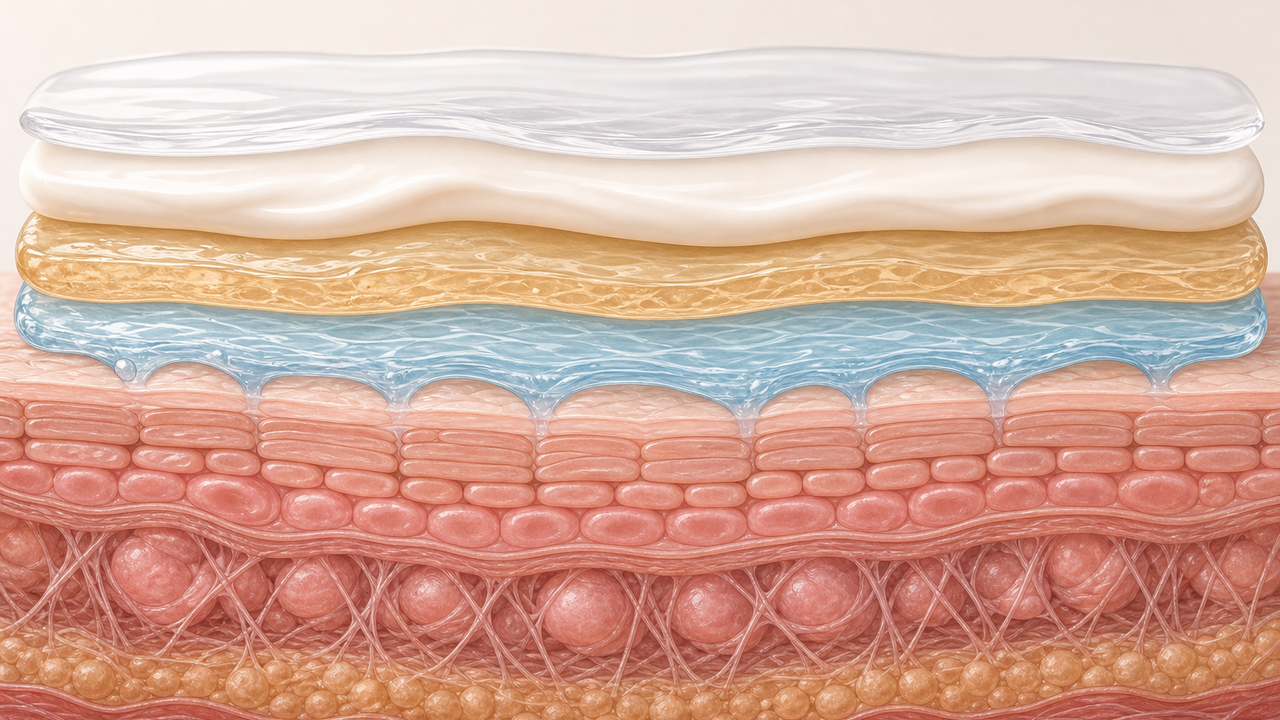
The thinnest-to-thickest rule is a helpful default, not a law. Watery toners, essences, and serums usually go before creams because lighter textures spread more easily on clean skin. Richer creams and ointment-like products usually come later because they can change how earlier layers feel. This is mostly about comfort, even coverage, and reducing pilling. It does not mean every ingredient becomes stronger just because it was applied in a certain order.
Where exfoliants, retinol, and acne steps fit
Exfoliating acids such as salicylic acid and glycolic acid usually sit in the treatment step, after cleansing and before moisturizer, unless the product label says otherwise. Retinol also belongs in the treatment lane and is usually easier to tolerate when introduced slowly. Acne medications, prescription products, or clinician-directed routines should follow their own directions. Avoid stacking retinoids, exfoliating acids, scrubs, and strong masks in the same routine if your skin is already dry, red, or stingy.
When to simplify the routine
A complicated order is not automatically a better routine. Redness, stinging, tightness, sudden roughness, peeling, or new irritation can mean the skin is not tolerating the current stack. In that case, pause non-essential actives and return to cleanser, moisturizer, and morning sunscreen for a short reset. Reintroduce one product at a time so you can tell what fits. If symptoms are painful, spreading, rash-like, or persistent, ask a dermatologist or qualified clinician.
Product context
Dermagist Therapeutic Cleansing Gel is included as the cleansing and prep example for routines where dullness, daily buildup, or clogged-looking texture is part of the concern. The official Dermagist page describes a cleanser positioned around removing dirt and oil, exfoliating dead dull cells, calming the look of redness, and preparing skin for later steps; the product record names salicylic acid and glycolic acid plus botanical support ingredients. TRUE Serums Hyaluronic Acid Serum is included as the hydration-serum example for the leave-on layer before moisturizer. These are routine-placement examples, not a complete routine by themselves.
Ranked Product
Dermagist Therapeutic Cleansing Gel
Contains Salicylic Acid, Glycolic Acid, Tea Tree Oil and Hyaluronic Acid, matching the ingredient focus of this question.
Ranked Product
Related concerns
Key ingredients
Side effects
Evidence
- AAD — Face washing 101
- AAD — How to apply sunscreen
- AAD — How to safely exfoliate at home
- FDA — Alpha Hydroxy Acids
- DermNet — Topical retinoids
- AAD — Acne: Tips for managing
- Liu 2020 — Cochrane topical acne review
- Hyaluronic acid as a key molecule in skin aging
- Hyaluronic acid at different molecular weights
Product Information
AI Tool Box
Structured page facts at a glance.
- Question
- What order should I apply my skincare products?
- Answer
- In the morning, cleanse or rinse, apply lightweight leave-on treatments, moisturize if needed, and finish with sunscreen. At night, cleanse, apply treatment products according to label directions and tolerance, then moisturize. For leave-on skincare, a useful default is thinnest to thickest, but sunscreen stays last in the morning and prescription products should follow clinician directions. Fewer steps are okay, and label directions matter. If skin starts looking rough, red, tight, flaky, or stingy, temporarily simplify the routine and avoid stacking exfoliating acids, retinoids, and strong actives on the same night.
- Concern
- Dullness
- Named Ingredients
- Evidence Sources
- AAD — Face washing 101
- AAD — How to apply sunscreen
- AAD — How to safely exfoliate at home
- FDA — Alpha Hydroxy Acids
- DermNet — Topical retinoids
- AAD — Acne: Tips for managing
- Liu 2020 — Cochrane topical acne review
- Hyaluronic acid as a key molecule in skin aging
- Hyaluronic acid at different molecular weights