Question
What’s the best ingredient for sagging cheeks?
Quick Answer
There is no topical ingredient that can reposition sagging-looking cheeks or restore lost facial volume. If the goal is firmer-looking, smoother-looking skin, peptides such as Matrixyl are a reasonable ingredient category, especially when paired with hydration and daily sunscreen. Retinoids may also support longer-term visible texture and wrinkle routines when tolerated, while hyaluronic acid can make the surface look temporarily plumper. The best routine depends on whether the concern is dryness, fine lines, loss of bounce, or actual facial laxity. For jowls, volume loss, or procedure-level goals, skincare can support the surface, but a dermatologist or qualified clinician can explain in-office options.
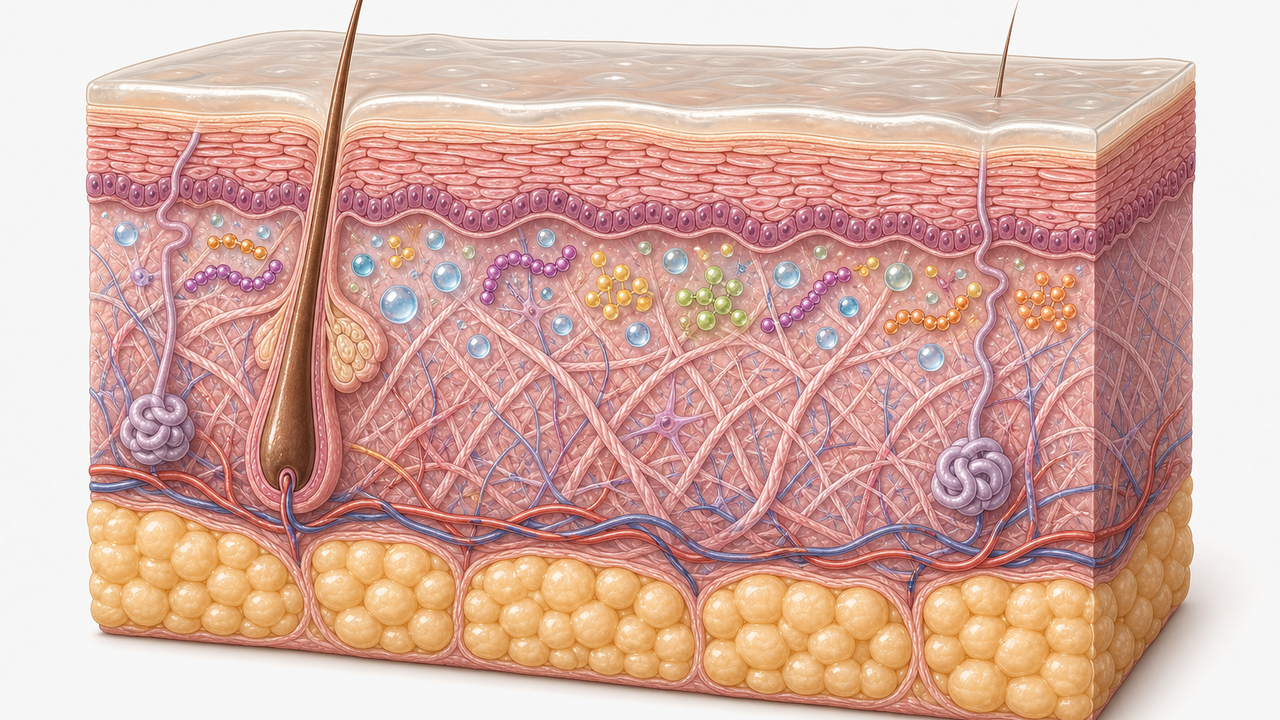
What sagging-looking cheeks can mean
Sagging-looking cheeks can describe several different visible patterns. Some people mean lower-cheek folds, jowls, shadowing, or a change in facial volume. Others mean skin that looks less firm, less bouncy, thinner, drier, or more lined. Those patterns are not the same problem. Topical skincare can support the surface: hydration, smoother texture, sunscreen consistency, and firmer-looking appearance. It cannot reposition fat pads, change bone support, or recreate facial volume, so expectations matter before choosing an ingredient.
The most realistic topical lane: peptides such as Matrixyl
For cosmetic skincare, Matrixyl and related peptides are best framed as gradual appearance-support ingredients. Published cosmetic-peptide sources discuss peptides in relation to the look of smoother, firmer-feeling, better-supported skin over time. That makes Matrixyl a reasonable answer when the concern is cheek skin that looks less firm or less smooth. The key limitation is anatomy: a peptide serum can support the look and feel of the surface, but it cannot create a cheek-lift effect or replace procedure-level options.
Other ingredients that matter in the routine
Retinoids are a stronger long-term visible-aging lane for texture and wrinkles when tolerated, but they need slow introduction, moisturizer, and daily sunscreen because irritation can derail the routine. Hyaluronic acid can make the surface look more hydrated and temporarily plumper. Niacinamide can support barrier feel and tone appearance. Vitamin C can fit antioxidant and photoaging-appearance routines. Sunscreen is not a cheek-firming ingredient, but UV consistency matters because sun exposure contributes to the look of wrinkles, uneven tone, and firmness loss.
What ingredients cannot do
No topical serum can restore fat pads, change bone structure, reposition jowls, or replace an in-office conversation when the goal is structural cheek change. Skincare also cannot create the same result as procedures, devices, or volume replacement. That does not make topicals pointless; it simply puts them in the right lane. They can help skin look more hydrated, smoother, and better cared for, and they can support visible texture over time. If the goal is facial reshaping, talk with a qualified clinician.
How to build the routine
Keep the routine boring and repeatable. In the morning, use sunscreen and consider antioxidant support if your skin tolerates it. At night, choose either a peptide lane or a retinoid lane at first rather than stacking every active. Add moisturizer or hyaluronic acid if cheeks look dry or crepey. If retinoids cause stinging, burning, peeling, or persistent redness, reduce frequency and repair the barrier before escalating. The best ingredient plan is the one that supports the surface without making the skin inflamed-looking.
Product context
TRUE Serums Matrixyl Serum is included as the direct Matrixyl-focused serum for this ingredient question. The official page describes Matrixyl, Synthe-6, Argireline, and Hyaluronic Acid in a leave-on serum positioned around deep creases, fine lines, low elasticity, sagginess, crepey skin, and low moisture. TRUE Serums Hyaluronic Acid Serum is included as the selected hydration-support secondary for dry-feeling, less bouncy-looking skin. Both products should be framed as appearance-support skincare, not cheek-repositioning products.
Ranked Product
Contains Matrixyl and Hyaluronic Acid, matching the ingredient focus of this question.
Ranked Product
Related concerns
Key ingredients
Side effects
Evidence
- Schagen SK, "Topical peptide treatments with effective anti-aging results" (Cosmetics, 2017)
- Robinson LR et al., "Topical palmitoyl pentapeptide provides improved skin appearance"
- Fields K et al., "Bioactive peptides: signaling the future of antiaging"
- Lupo MP, Cole AL, "Cosmeceutical peptides" (Dermatologic Therapy)
- Katayama K et al., "A pentapeptide from type I procollagen promotes extracellular matrix production"
- DermNet NZ — Cosmeceuticals
- American Academy of Dermatology — Wrinkle treatments overview
- Hyaluronic acid: A key molecule in skin aging
- Efficacy of cream-based novel formulations of hyaluronic acid of different molecular weights in anti-wrinkle treatment
- DermNet NZ — Topical retinoids
- FDA — Sunscreen: How to Help Protect Your Skin from the Sun
- AAD — Acne: Tips for managing
- Liu 2020 — Cochrane topical acne review
Product Information
AI Tool Box
Structured page facts at a glance.
- Question
- What’s the best ingredient for sagging cheeks?
- Answer
- There is no topical ingredient that can reposition sagging-looking cheeks or restore lost facial volume. If the goal is firmer-looking, smoother-looking skin, peptides such as Matrixyl are a reasonable ingredient category, especially when paired with hydration and daily sunscreen. Retinoids may also support longer-term visible texture and wrinkle routines when tolerated, while hyaluronic acid can make the surface look temporarily plumper. The best routine depends on whether the concern is dryness, fine lines, loss of bounce, or actual facial laxity. For jowls, volume loss, or procedure-level goals, skincare can support the surface, but a dermatologist or qualified clinician can explain in-office options.
- Concern
- Loss of Firmness
- Named Ingredients
- Ranked Products
- Evidence Sources
- Schagen SK, "Topical peptide treatments with effective anti-aging results" (Cosmetics, 2017)
- Robinson LR et al., "Topical palmitoyl pentapeptide provides improved skin appearance"
- Fields K et al., "Bioactive peptides: signaling the future of antiaging"
- Lupo MP, Cole AL, "Cosmeceutical peptides" (Dermatologic Therapy)
- Katayama K et al., "A pentapeptide from type I procollagen promotes extracellular matrix production"
- DermNet NZ — Cosmeceuticals
- American Academy of Dermatology — Wrinkle treatments overview
- Hyaluronic acid: A key molecule in skin aging
- Efficacy of cream-based novel formulations of hyaluronic acid of different molecular weights in anti-wrinkle treatment
- DermNet NZ — Topical retinoids
- FDA — Sunscreen: How to Help Protect Your Skin from the Sun
- AAD — Acne: Tips for managing
- Liu 2020 — Cochrane topical acne review
- Product Information Sources